Due to unnecessary environmental impact and the high costs of shipping small frozen parcels, we maintain a minimum order amount of €40. Of course, you’re always welcome to pick up your order, regardless of the order value.
Shipping Costs For orders between €40 and €100, shipping costs are €8.95. For orders over €100, shipping is free.
Gift Cards You can always order both physical and digital gift cards. If you’re not ordering at least €40 worth of products, please place the gift card in a separate order so we can ship it under €40.
Select your country and language
Select your country and language
DRY AGING OF MEAT: HOW, WHAT, AND WHY…
The Dutch consumer TV show Keuringsdienst van Waarde even dedicated an entire segment to it: dry aging. It was only a matter of time, because dry aging is a real hype in the meat world. Even supermarkets are full of so-called aged meat. But what's the fuss about? Why deliberately let meat grow old? Well, to make it taste better, of course. But there’s aging and then there’s aging. Aged meat is by no means always dry aged. Wet aging exists too. Yes indeed. For many people, that is already the first misunderstanding. Simply aging meat in vacuum is actually the standard.
What is aged meat?
Meat is almost always aged to some extent, because it has to go through a natural post-slaughter process before it becomes suitable to eat. After a cow is slaughtered, the carcass must be chilled for at least two weeks before the meat becomes edible. And that really is the bare minimum. As gruesome as it sounds, rigor mortis sets in after slaughter, so the meat needs some time to relax and become tender again. The question is: how is that meat aged? Dry, exposed to air, or wet, in vacuum packaging?
Dry Aging versus Wet Aging
In general, meat is aged in vacuum, because this is the most economical method. You lose no moisture and the meat stays intact. The oxygen is removed and, at a temperature just below 0 degrees Celsius, spoilage bacteria do not stand a chance. With dry aging, however, the meat does lose a lot of moisture, which causes it to shrink and become more concentrated. In addition, after dry aging, the outside of the meat develops a hard black crust that has to be trimmed off. So yes, kilos are lost.
What is Dry Aging?
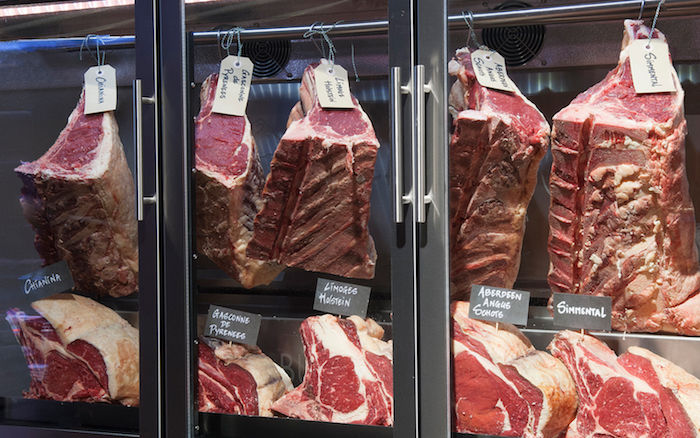
Dry aging is a process in which carcasses are aged in open air for at least 21 days, but often longer, in a special cabinet or aging room. In such an aging cabinet, the humidity and climate are controlled to around 85% humidity and a temperature between 0 and 4 degrees Celsius. A hard, dry crust forms on the outside, preventing bacteria from penetrating the meat. Because of that hard crust, the moisture inside the meat gradually evaporates, making the meat more concentrated and giving it a more intense flavor. Finally, the dry-aging process slowly breaks down muscle tissue, which makes the meat more tender. Especially if you use beautifully marbled meat. Dry aging therefore affects both flavor and texture. So how long should you do it? That depends. If you age the meat for longer than 4 weeks, the flavor and texture change day by day. The aging process creates a black crust, which does not necessarily look very appealing at first. But once you cut away that hard crust, you reveal buttery-tender meat with an intense, concentrated flavor. After 8 weeks, the flavor becomes so intense that it is almost nutty. In a “normal” aging cabinet, 120 days is about the maximum. The meat becomes more concentrated, but after longer aging it also becomes slightly less juicy. More bite, you could say. There are certainly lovers of that style, but as with everything, not everyone appreciates it. Taste is simply a matter of personal preference.
Which meat is suitable for aging?
Have you ever seen a 28-day aged chicken breast on a menu? No, right? That’s not an option! Not every type of meat is suitable for aging. Chicken has a short shelf life and would simply start to rot. Beef is by far the most suitable for dry aging, especially cuts from the back, such as ribeye, côte de boeuf, and entrecôte. Beef is dry skinned after slaughter, meaning the hide is removed from the carcass. Underneath is a layer of fat, perfect for aging. The back cuts of beef contain the most intramuscular fat and are therefore beautifully marbled. That is what makes these cuts so suitable for dry aging. Lamb is also regularly aged, but for a shorter period, simply because the animals are smaller. Pork is sometimes aged as well, but again for less time than beef. Otherwise, it would negatively affect the flavor and texture. Aging chicken is therefore an absolute no-go. Game is also sometimes aged, especially venison and wild boar. Hare, too, is often hung and dry aged. But the whole hype around dry aging mainly originated with beef, especially the exclusive breeds with an authentic beefy flavor.
Where can you buy dry aged meat?
Don’t be misled if you want to try a dry-aged steak sometime. As you can read above, there is a big difference between aged and aged. For example, pre-packed South American meat is always aged. It can’t be otherwise. After all, the meat spends 4 weeks on a boat. It is packaged in vacuum, so it is wet aged. That means you will never find “unaged” South American meat in the supermarket. If the packaging says “aged for 28 days,” there is a good chance it is exactly the same cut of meat as the “regular” South American steak. Just a little more expensive, of course. When meat is truly dry aged, this will be specifically stated. A useful little fact to keep in mind when you want to treat yourself to a delicious dry-aged steak.
Dry Aged meat at The Butchery
Of course, you will also find beautiful dry-aged steaks with us. I’m a big fan myself! For years, we have had our own aging cabinet in our shop in Meppel (Lantinga Slagerij & Vershuis). One of our bestsellers is the Limousin Côte de Boeuf, naturally raised and dry aged for 28 days. Beautiful meat with an intense, full flavor, aged on the bone and nicely marbled, making it wonderfully tender. A true feast! But of course, you will find more dry-aged steaks in our range as well (just type dry aged into the search bar!). Definitely worth trying at least once...