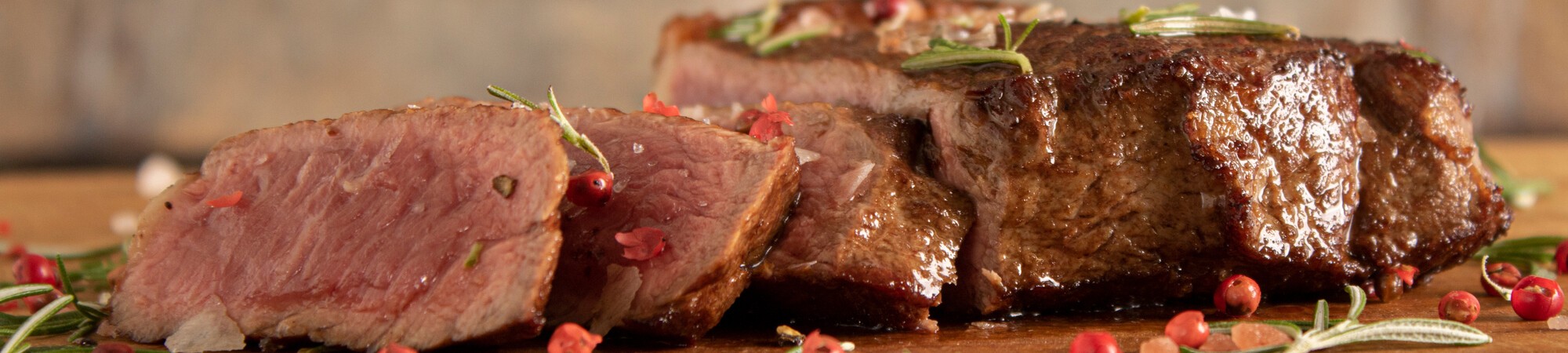
What is an entrecote?
An entrecote is a steak cut from the short loin of the cow. You can find it on the upper part of the back, just behind the ribs and before the rump. It is part of the large, elongated back muscle that runs along both sides of the spine.
You can recognize an entrecote by the strip of fat on the top. This fat melts slowly during cooking, keeping the meat juicy and giving it a distinct beef flavor. Unlike the ribeye, the entrecote has less intramuscular fat, which provides a firmer texture and a purer meat flavor.
Entrecote is therefore a more robust piece of meat. It has a bit more bite than the ribeye, but is still tender enough to cut through effortlessly. This makes it popular with both experienced steak lovers and people buying an entrecote for the first time.
Why the name entrecote?
The name entrecote comes from French and literally means “between the ribs”. Originally, the term was used for all meat cut from the rib area. Today, entrecote specifically refers to the steak from the short loin with that characteristic strip of fat.
In America and Canada, the same cut of meat is known as a New York Strip, strip steak, or striploin. In the Netherlands, it is also called a sirloin steak (lendebiefstuk). Fun fact: if you look at a t-bone, you'll see a tenderloin (tournedos) on one side and an entrecote on the other — the exact same cut of meat, but on the bone.
What is the difference between entrecote and ribeye?
Entrecote and ribeye are often confused. Understandable, because they both come from the back of the cow. Yet they are two very different steaks, each with its own character.
The entrecote comes from the short loin, slightly further back. The meat has a firmer texture, a better bite, and is relatively lean. The flavor and juiciness here come mainly from the strip of fat on the outside. That strip of fat is exactly what makes the entrecote so recognizable: when cooked crispy, it provides a ton of flavor you won't find in any other steak.
The ribeye comes from the front of the back. This steak is heavily marbled: the fat runs through the meat and often forms a core in the middle (the 'eye', hence the name ribeye). This fat melts during cooking and provides a lot of tenderness and intense flavor.
Which one you choose is a matter of personal preference. Do you want a steak with a good bite and a crispy strip of fat? Then choose the entrecote. Do you want a fattier flavor and a slightly more tender steak? Then the ribeye is the way to go.
We have listed all the differences between the entrecote and ribeye for you, so you know exactly which steak suits you best.
Why buy entrecote at The Butchery?
At The Butchery, we understand that a good entrecote depends entirely on the butchery skills. As soon as the meat arrives, one of our Master Butchers immediately performs a quality control check. We critically inspect the entrecote for smell, texture, and appearance. Only meat with absolute premium quality and the right marbling makes the cut. Only after that strict inspection do we make your steak 100% grill-ready.
Triple trimmed
Every entrecote is triple trimmed by us, hand-trimmed three times until only the meat and the strip of fat remain. Because that strip of fat needs to stay on — it's the flavor enhancer of the entrecote and protects the meat from drying out.
In practice, for the entrecote, this means the following:
- We cut away the so-called chain and the tough membrane for you.
- We cut the entrecote entirely by hand and meticulously trim away all irregular edges.
- We halve the thick fat cap on top. This way, exactly enough fat remains without it overpowering the meat. The ideal meat-to-fat ratio.
That might sound like a detail, but it makes the difference between a steak you have to trim at the table and one you can put on the grill straight from the packaging. No hassle, no waste.
Special 4-layer vacuum packaging
After cutting, we immediately pack the entrecote in our specially developed 4-layer vacuum film. This ensures the steak optimally retains its quality and has a longer shelf life in the freezer. Good to know: this packaging is heat-resistant, so you can cook the entrecote sous-vide right in our packaging.
Flash-frozen
As soon as the entrecote is packed, it goes into our innovative flash-freezer, where it is frozen within an hour at a temperature of -40°C. We do this at the exact moment the steak has reached its optimal tenderness. Because the entrecote is frozen so quickly, the cell structure remains intact. The difference compared to slow freezing? Slow freezing forms large ice crystals that damage the muscle fibers. As a result, the meat loses moisture and flavor when thawed. With flash-freezing, this doesn't happen. It doesn't get any better than this.
100% fair weight guarantee
Finally, you always get the weight you pay for with us. Our weight guarantee is simple: packaging and meat juices do not count. Sounds obvious, but in the online meat industry, it isn't always the case.
High customer ratings
You can see the result of our craftsmanship in our customers' experiences: on the product page of each specific entrecote, you'll find 5-star reviews that confirm our craftsmanship.
Want to know more about how we work? Read all about our craft.
Which breed of entrecote should you choose?
Which entrecote suits you best depends on your taste preference, the occasion, and your budget. In our assortment, you will find entrecotes from more than 10 breeds and origins, so we understand it can be quite hard to choose. Below, we've listed the options for you.
Budget-friendly options
If you ask us for a premium steak at an accessible price, we quickly point to our grass-fed entrecotes. Specifically, the Blonde d’Aquitaine, Argentine Black Angus (Premium Grassfed), and Simmentaler are absolute highly recommended choices.
Due to their natural, grass-fed diet, these steaks are leaner than the grain-fed variants. The meat has a slightly firmer bite and a grassy undertone in its flavor. A nice bonus: this lifestyle also directly ensures that the meat has better nutritional values, with more omega-3 fatty acids and a higher vitamin E content.
Bert-Jan's favorite: USDA Black Angus
If you ask Bert-Jan for his favorite entrecote, he immediately chooses the American USDA Black Angus. To him, this is the ultimate combination of tenderness and an honest origin.
These cattle grow up 100% naturally according to the strict NHTC (Non Hormone Treated Cattle) guidelines, which guarantees that no hormones or preventive antibiotics are used. The animals graze on vast pastures and receive a plant-based diet of grass, grains, and corn. This specific diet creates the rich marbling that melts straight through the meat during cooking.
A quick note on that marbling: with USDA beef, the quality is officially graded. USDA Prime is the highest class — only about 3% of all American beef falls into this category. That says something about the selection we make. This natural way of raising cattle takes more time, but according to Bert-Jan, it results in the very best quality beef.
Dry-aged entrecote
Do you want to serve an exclusive taste experience? Then choose a dry aged entrecote. During this process, we let the meat age for at least 21 days in special climate cells at a constant temperature and humidity. This causes the moisture to evaporate, resulting in a concentrated, almost nutty beef flavor. At the same time, natural enzymes break down the connective tissue, making the steak even more tender.
For an entrecote, this process is extra special. The fat cap on top protects the meat during aging and absorbs the flavors even better. This fat eventually melts in the pan and adds even more flavor to your meat. The result is a steak with a depth of flavor that you simply won't find in a "normal" entrecote.
Want to know more about this process? Read our blog about dry aging.
Premium and exclusive
For the absolute ultimate, choose Wagyu. Where a regular entrecote is known for its firm bite, the extreme fat marbling of Wagyu literally melts on your tongue. This is because Wagyu fat has a lower melting point than regular beef fat. It already starts melting at body temperature, which creates that characteristic texture.
Within our assortment, you can choose from an Australian Wagyu entrecote or the absolute world top: Japanese Wagyu. With the Japanese variant, you can choose from three quality classes: A3, A4, and A5. The higher the grading, the more intense the marbling. An A5 is the cream of the crop — less than 1% of all Japanese beef achieves this classification. Want to know more? Check out our Wagyu page.
Unsure which breed suits you? Feel free to contact us, because our butchers are happy to help you decide.
How do you cook the perfect entrecote?
Cooking a good entrecote doesn't have to be complicated, but it does require some precision. The basics: take the steak out of the fridge at least an hour in advance and pat it dry. Cook it first on its fat edge in a cold pan. This way, the fat slowly renders out and the edge becomes crispy. Then lay it flat and cook for about 1 minute per centimeter of thickness per side. In the last few minutes, add butter, thyme, and garlic, and baste the steak. Then let it rest for 5 to 10 minutes under aluminum foil and finish with sea salt.
Do you want the complete step-by-step explanation including a video? In our blog, chef Ruben Meijboom explains exactly how to cook the perfect entrecote in 8 steps.
Core temperature for entrecote
Use a meat thermometer for the perfect result. Maintain the following temperatures:
- Rare: 50–52°C
- Medium-rare: 53–54°C (our recommendation)
- Medium: 55–58°C
- Medium-well: 60–64°C
Important: meat continues to rise in temperature by 2–3 degrees after cooking (carryover cooking). So take your steak off the heat slightly before your desired final temperature.
Entrecote on the BBQ
The entrecote and the barbecue are a golden combination. The strip of fat ensures that the steak remains deliciously juicy under high, direct heat. Briefly sear the steak over direct heat on both sides and then move it to indirect heat until it reaches the desired core temperature. For medium-rare, take it off the grill at 52°C, so it cooks through to 54°C while resting.
Do you have a whole entrecote roast? Then the reverse sear method works ideally: first cook slowly on indirect heat at 120°C until a core of 45°C, then sear hotly until 52°C. This works very well on a kamado like the Big Green Egg. Afterward, carve the meat into thick slices at the table.
Entrecote in the oven
You can perfectly prepare a whole entrecote or a thick steak of 4 centimeters or more in the oven using the reverse sear method. Preheat the oven to 120°C, slowly cook the meat until just below the desired core temperature, and then briefly sear the steak in a blazing hot pan.
Which wine goes with entrecote?
The robust flavor of the entrecote calls for a powerful red wine with sufficient tannins. The fat of the entrecote and the tannins in the wine form a perfect match: the meat takes the sharp edges off the wine, while the wine provides a wonderful counterbalance to the fat.
Our favorites are a Cabernet Sauvignon, a robust Syrah, or a Malbec. A Rioja Reserva is also an excellent pairing for a dry aged variant.
Recipes with entrecote
You can go in any direction with an entrecote. Be inspired by our favorite recipes:
View all recipes with entrecote on our recipes page.
Ordering entrecote at The Butchery
A good entrecote starts at the right butcher. At The Butchery, you can choose from more than 10 types of different beef breeds — from grass-fed breeds for a competitive price to Japanese A5 Wagyu for a special occasion. Every piece is hand-trimmed three times by our Master Butchers, so you get a steak with the perfect meat-to-fat ratio. Then we pack it in our special vacuum packaging and freeze it within the hour at -40°C.
If you order on a workday before 11:00 AM, we will deliver throughout the Netherlands and Flanders that same evening, deep-frozen via refrigerated transport or with dry ice. And thanks to our weight guarantee, you always pay for the weight you actually receive.
Do you want to buy entrecote but are unsure which breed or thickness fits best? Feel free to contact our butchers — we are happy to think along with you.
Frequently asked questions about entrecote
Do you cook entrecote in oil or butter?
Neither — at least, not at the beginning. Because you first render the entrecote on its fat edge using the cold-pan method, you cook the steak in its own fat. Only in the final minutes do you add real butter, garlic, and thyme, and baste the steak for extra flavor.
How do you season an entrecote?
Sprinkle the steak with salt and freshly ground black pepper before cooking. Nothing more is needed. After resting, carve the meat into slices and sprinkle some extra sea salt flakes on top.
Which sauce pairs best with entrecote?
An entrecote has so much flavor of its own that we honestly think a sauce is a waste. Do you still prefer eating it with one? Then choose a classic béarnaise, pepper sauce, or red wine sauce. For a fresh contrast, you can also opt for a chimichurri or salsa verde.
Should I remove the strip of fat from the entrecote?
No, absolutely not. At least not before cooking. That strip of fat is exactly what makes the entrecote so delicious. It protects the meat from drying out and releases a lot of flavor during cooking. Are you not a fan of eating fat? Cut it off after cooking. This way, you still get all the flavor without having to eat the fat.
How many grams of entrecote per person?
Count on 200 to 300 grams per person, depending on the side dishes. Are you serving a multi-course menu? Then 200 grams is more than enough. Is the entrecote the centerpiece? Then go for 250 to 300 grams. For a whole entrecote roast, we estimate 300 grams per person, because you always lose a few edges when carving.
What do you serve with an entrecote?
Side dishes with some body pair well with the robust flavor of an entrecote. Think of fries, a potato gratin, or pan-fried potatoes with rosemary. In terms of vegetables, you can go for grilled asparagus, sautéed mushrooms, or roasted cherry tomatoes. Our favorite: a combination of crispy fries, a handful of arugula with Parmesan, and a pat of herb butter on the steak.
Where can I buy the best entrecote?
At The Butchery, you buy entrecotes that are hand-trimmed by our Master Butchers, vacuum-packed, and flash-frozen. Whether you go for grass-fed or exclusive Japanese Wagyu, you'll always find a top-level steak with us. Want to know what others thought of a specific breed? On the product page of each entrecote, you can see the average score of 5 stars and the accompanying customer reviews.
How do I order entrecote online?
Ordering entrecote is easy via our webshop. Choose the breed and weight that suits you, place your order, and we'll do the rest. Order on a workday before 11:00 AM, and we will deliver the same evening throughout the Netherlands and Flanders. Your entrecote is shipped deep-frozen via refrigerated transport or with dry ice, so the quality is guaranteed right to your front door.