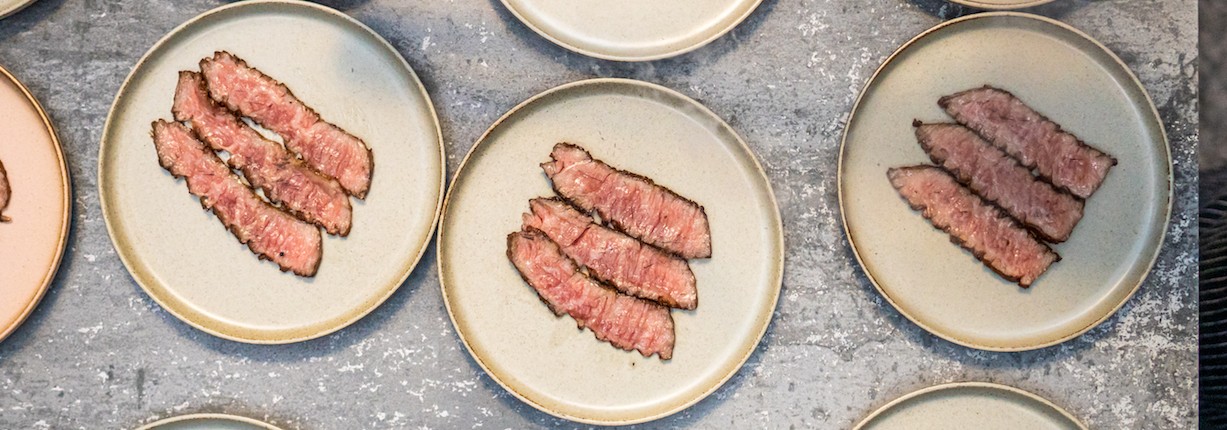
The Wagyu Specialist of the Netherlands
For Wagyu of absolute top quality, connoisseurs choose The Butchery. And that is not without reason. There are three reasons why we are known as the number one Wagyu specialist in the Netherlands:
1. World’s best Wagyu selection
We sell carefully selected Wagyu of the very highest quality. Our meat comes from the best regions in the world, with Japan naturally being the absolute cream of the crop.
At The Butchery, we only sell Full blood Wagyu and the highest grades of marbling.
2. Pure craftsmanship in our own butchery
All cuts of meat are hand-trimmed
No trimming loss: we trim the steak in such a way that you don't have to do anything to it, meaning you only pay for the meat you eat.Perfect fat-to-meat ratio: our Master Butchers know exactly how much to trim so that the texture and quality are perfectly showcased.100 percent grill-ready steaks: the steak is cut so that it is instantly ready for the grill or the pan.
3. Flash-frozen delivery
After carefully cutting and trimming the Wagyu, we individually vacuum-seal the meat in the highest quality vacuum packaging. Within an hour, the meat is flash-frozen
Flavor and texture are optimally preserved.
No crystal formation in the meat.
Consistent top quality.
Longer shelf life.
What is Wagyu beef?
Wagyu is perhaps the Bentley of cattle breeds, and Japanese Wagyu beef is the absolute pinnacle of that. The real deal, so to speak. Literally translated, Wagyu means Japanese cow (Wa = Japan, Gyu = cow), and while American and Australian Wagyu are naturally also of high quality, Japanese A5 Wagyu is truly next level.
The meat surpasses perhaps every other cattle breed in its degree of marbling, fat and meat color, texture, and nutty flavor that is truly incomparable. Although, of course, there is no accounting for taste.
4 types of Japanese Wagyu
In principle, Wagyu is a collective name for 4 Japanese cattle breeds, namely:
Japanese Black (Kuroge Washu) – 80% of cattle in Japan.Japanese Brown (Akage Washu) – 18% of cattle in Japan.Japanese Shorthorn (Nihon Tankakushu) – 1-2% of cattle in Japan.Japanese Polled (Mukaku Washu) – less than 1% of cattle in Japan.
The most popular breed is Kuroge Washu (Japanese Black), which is the only breed to receive an A4 and A5 grading. There are indeed multiple grades in Wagyu beef, from which you can tell if you are dealing with the real deal.
Kagoshima vs. Australian Wagyu, what do you choose?
The choice between Japanese and Australian Wagyu is not a matter of better or worse, but of taste and experience. Both breeds are world-class, but with an entirely unique character. To help you choose, we have listed the main differences here:
Characteristic Kagoshima Wagyu (Japan) Australian Wagyu (Australia)
Grade
A3, A4, A5+
BMS 8–9
Marbling
Extreme, BMS 8–12
Very high, BMS 8+
Origin
Kagoshima, Japan
New South Wales, Australia
Intensity
5 stars
4 stars
Price
Premium
Excellent value
Ideal for
Once in a lifetime experience
Luxury home dinner
Portion advice
80–120 grams per person
120–180 grams per person
Which Wagyu do you choose?
Anyone who truly wants to experience the buttery umami flavor and texture of Wagyu should choose Japanese Wagyu A5. This meat is truly incomparable. However, not everyone can appreciate this buttery meat, because even though the fat melts on your tongue, the meat remains rich in fat, and simply put, not everyone likes that.
Do you want to experience Wagyu, but prefer a little more bite and a meatier flavor? Then Australian Wagyu might be more your thing.
Wagyu grading
The grading of Wagyu is done by the Japan Meat Grading Association. They grade the meat on a scale from A1 to A5, making use of the Beef Marble Score (BMS). This indicates how much intramuscular fat the meat contains. The higher the BMS, the richer and more intense the flavor. The grades are as follows:
Grade A1: Low – marble score 1.Grade A2: Below average – marble score 2.Grade A3: Average – marble score 3 to 4.Grade A4: Good – marble score 5 to 7.Grade A5: Excellent – marble score 8 to 12.
We only sell Wagyu of the highest quality with a score from A3 up to A5. But even with this, we remain critical. Our Master Butchers inspect the meat again by hand to ensure it truly meets the standards.
If we feel a steak is actually an A4, then we sell it as an A4. It's that honest. You always get exactly the quality you pay for.
Preparing Wagyu beef
Wagyu is an experience in itself, and this beautiful piece of meat deserves the very best preparation. Because the fat melts at a lower temperature than other beef, slightly different rules apply regarding timing, doneness, and resting the meat.
Cooking Wagyu in a pan (recommended)
Wagyu is best prepared in a pan or on a griddle. This ensures that you can catch the fat (read: flavor) and have more control over the doneness. Moreover, flames can quickly flare up over an open fire when the fat begins to melt. Follow these steps and your Wagyu preparation cannot go wrong:
Take the meat out of the freezer the night before and let it thaw slowly in the refrigerator.
Let the steak come to room temperature outside the refrigerator for 30 minutes before cooking.
Let a stainless steel or cast-iron pan heat up nicely and gradually over medium-high heat. To be sure the pan is hot enough, you can drop a tiny amount of water into the pan. If it sizzles away immediately, the pan is hot enough.
Cut a small piece of fat off the steak and place it in the pan. The Wagyu fat will ensure that you can fry the steak in its own fat shortly.
Fry the steak for 2-3 minutes per side for medium doneness.
Let the meat rest for another 10 minutes loosely covered with aluminum foil.
Season the meat with some coarse sea salt. No other spices, as this will only mask the special flavor of the Wagyu. That would be a shame, right?
Wagyu on the BBQ
We strongly advise against Wagyu on an open grate. Because there is a huge amount of fat in Wagyu, it all drips into the fire. This causes large flare-ups, which will quickly burn the meat.
Do you still want to cook outside? Then use a plancha or a skillet. This allows you to cook the meat beautifully in its own fat without creating large flare-ups.
Pro-tips from our Master Butchers
Cut the meat into thin slices after resting. Thanks to the beautiful marbling, the meat will then literally melt on your tongue.
Let the meat come to room temperature and ensure you cook it medium. This allows the fat to melt beautifully through the meat, giving you maximum flavor.
Because the meat contains a lot of fat, you need a smaller amount, especially with A4 and A5 Wagyu:
For Japanese Wagyu A4 and A5, allow 80-120 grams per person.
For Australian Wagyu, allow 120-180 grams per person.
Cooking Wagyu Ribeye
Wagyu ribeye is a 100% flavor experience, but it's naturally not a meat you eat every day. It is very intense meat, but also very exclusive. So you don't want to ruin that. Do you want to know how to beautifully prepare an A5 Wagyu ribeye in the pan? Then take a look at the video below; it takes less than two minutes.
VIDEO
Cooking Wagyu Entrecôte (Striploin)
Not a fan of ribeye? Our chef Ruben has made a similar video, but for the entrecôte. The preparation is slightly different than for the ribeye, but you'll have to see that for yourself!
VIDEO
Wagyu recipes and inspiration
Wagyu is a culinary masterpiece in itself, but with the right preparation, you can take it to a level that even restaurants will be jealous of. We have listed a number of our favorite recipes for you:
Is there nothing for you? No problem, we have plenty of other recipes with Wagyu. That's what you get when it's your ambassadors' favorite.
What to look out for when buying Wagyu?
Wagyu is perhaps the most exclusive cut of beef in the world, and that naturally comes with a price tag. If you buy Wagyu beef, you want to be certain that you actually have top quality in your hands. That is why we have created a checklist with 4 criteria for you:
Transparency about the grade: is there clear communication about the origin and grading of the Wagyu?Marbling: does the cut have a BMS score of at least 8?
Butchery finish: has the cut been professionally trimmed, and do you truly get what you pay for (meaning no trimming loss)?
Delivery: Is the meat delivered flash-frozen for maximum preservation of texture and quality?
At The Butchery, all these boxes are ticked, and that is why we dare to call ourselves the premier Wagyu specialist of the Netherlands.
Which wine do you drink with Wagyu?
Such a beautiful cut of meat naturally calls for a top wine. That is why we asked a sommelier from Vinobox what his recommendation was. According to him, Wagyu demands wines with spicy to slightly sweet notes, without overpowering bitterness. You could consider:
Amarone: notes of fig, cinnamon, and chocolate.Argentine Malbec: red plums, sweet tobacco, and cocoa.White wine is also an option: full-bodied, oak-aged Chardonnay or Traminer blend.
Whatever you do, it is important that the meat is balanced. Therefore, avoid overly fruity wines or wines with high tannins.
Frequently asked questions about Wagyu
What is the difference between Japanese and Australian Wagyu?
Japanese Wagyu has a more extreme marbling and a more intense flavor. Australian Wagyu is slightly more accessible and better suited for a first introduction.
How many grams of Wagyu do you eat per person?
With Wagyu, you eat slightly less meat than you normally would with a steak. For Japanese Wagyu, aim for 80-120 grams. For Australian Wagyu, take 120-180 grams.
Can I refreeze Wagyu once it has been thawed?
Yes, you can. Thanks to our specially designed 4-layer vacuum packaging, you can safely refreeze Wagyu, provided you thaw it slowly.
What does BMS stand for?
BMS stands for Beef Marble Score. This indicates the degree of marbling, where a BMS of 1 is low and a BMS of 12 is the highest achievable.
Why is Wagyu so expensive?
Wagyu is quite a bit more expensive than other cattle breeds. This has to do with the special genetics, longer feeding times, strict selection, and limited production.
What is the difference between A4 and A5 Wagyu?
A5 Wagyu has a higher marbling and a more intense flavor. A4 is slightly less rich, but still of incredible quality. A4 is also slightly cheaper than A5 Wagyu.
Should I eat sauce with Wagyu?
It is usually better not to eat sauce with your Wagyu. The meat naturally has such a special flavor that it would be a shame to mask it with a heavy sauce. If you do want to eat sauce, go for light sauces and serve them on the side.