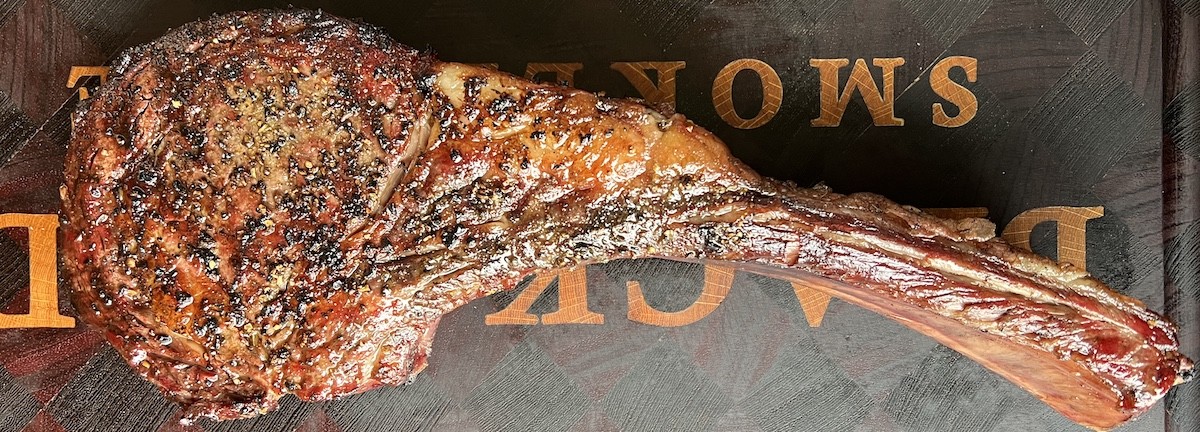
What is a tomahawk?
A tomahawk is essentially a ribeye with 15 to 20 centimeters of bone still attached. The meat is cut from the rib section of the beef, a part that sees relatively little movement. This results in a fine grain, soft texture, and plenty of marbling. The bone is "frenched," meaning all meat and fat are scraped off until only the bare bone remains. This bone is also where the steak gets its name, as it resembles a traditional Native American war axe (the tomahawk).
But the bone is more than just for show. Around the bone sits collagen that melts during preparation and seeps through the meat. This adds an extra layer of flavor and juiciness that you won't find in a boneless steak. Additionally, the bone acts as a heat conductor: the meat cooks more evenly, which is a major advantage for a steak of this thickness.
Tomahawk vs. cowboy steak vs. côte de boeuf
All three come from the same rib section, but the cut differs. With a tomahawk, the full rib bone protrudes. A cowboy steak has a shorter bone. And with a côte de boeuf, the rib piece is still attached but without that long protruding bone. In terms of taste, the difference is minimal; it’s mostly about the presentation. And a tomahawk on the table simply makes more of an impression than anything else.
What does a tomahawk taste like?
Anyone eating a tomahawk tastes the essence of a premium cut of beef. The flavor is similar to ribeye but with an extra dimension thanks to the bone. The fat and collagen around the bone melt slowly and soak deep into the meat.
The breed determines the character. A Wagyu tomahawk offers an almost buttery taste due to extreme marbling. If you choose Black Angus USDA Prime, you get a classic, full-bodied beef flavor. And with a dry-aged Rubia Gallega, you get nutty overtones and significant complexity.
How we prepare a tomahawk for you
When it comes to a tomahawk, the butchery work is extra precise. You’re dealing with a large piece of meat, a long bone that must be frenched, and a fat balance that needs to be just right. At The Butchery, every tomahawk receives the full attention of a Master Butcher. Specifically, it goes like this:
- First, we partially clean the bone.
- Then, the meat is cleared of tough connective tissue and bone membranes.
- Next, we hand-cut the rib section into steaks and carefully trim away all irregularities.
- Finally, the outer fat rim is halved for the ultimate meat-to-fat ratio, after which the steak is individually weighed, vacuum-packed in our 4-layer foil, and immediately flash-frozen at -40°C.
Curious about what that trimming process looks like? On our page about the art of craftsmanship, we show exactly what we do differently compared to other online butchers.
Why our 4-layer vacuum foil is ideal for a tomahawk
You often see the bone of a tomahawk easily puncture standard vacuum bags, causing the meat to lose its vacuum seal. This allows oxygen to reach the meat and leads to freezer burn. This is one of the reasons we developed special 4-layer vacuum foil.
This foil contains an extra layer of nylon, ensuring you never have leaky packaging again. This keeps the packaging airtight and maintains the maximum quality of the meat. Curious about the rest of our butchery work? Discover everything on our page about our craft.
Which tomahawk suits you?
It’s a steak you won’t always find at your local corner butcher. They simply don’t keep it in stock by default. At The Butchery, you can choose from several breeds, each with its own character.
- Australian Wagyu – The exceptional marbling of Wagyu combined with the beautiful presentation of a tomahawk. The intramuscular fat melts during preparation and gives a buttery flavor. It is the exact same steak that Salt Bae always prepares, but without all the show around it.
- Black Angus USA (USDA Prime) – The top 3% of all American beef. USDA Prime guarantees rich marbling and a full beef flavor. The all-rounder in our tomahawk assortment and Bert-Jan’s favorite.
- Rubia Gallega (dry-aged) – A Spanish breed with character. Rubia Gallega cattle are kept for a long time and grow up on a natural diet of grass and herbs. Additionally, dry-aging provides an even stronger nutty flavor. A tomahawk for the connoisseur.
Not sure which breed suits you? Feel free to contact us. Our butchers are happy to advise you based on the occasion and your budget.
Dry-aged tomahawk
The tomahawk is excellent for dry-aging! Just like the Côte de Boeuf, the tomahawk is cut from a large rib section, which naturally gives the meat extra flavor and juiciness. The dry-aging process makes this meat even more flavorful and tender, making it a perfect choice for lovers of rich flavors.
During the dry-aging process, the meat loses moisture, resulting in a more intense flavor. Moreover, the natural collagen in the meat breaks down, making it even more tender. Dry-aging requires a careful approach and significant butchery expertise. The entire rib section matures for between 21 and 60 days in a strictly controlled environment, where temperature, humidity, and air circulation are closely monitored. Only after this maturation do we trim off the dried crust and cut the tomahawks.
It is important to know that dry-aging involves significant weight loss (due to moisture loss and trimming the crust). Therefore, dry-aged meat is more expensive than non-aged meat. However, for lovers of premium meat and such a special taste experience, it is worth every penny!
Want to know more about this process? In our blog about dry-aging, you can read exactly how it works, how long it needs to age, and what the effect is on the flavor.
Preparing a tomahawk steak
Preparing a tomahawk is exciting—after all, it’s not an everyday steak. But with patience and a core thermometer, it is absolutely doable. The most important thing: take your time. This is not a steak you just quickly throw in the pan.
Preparation
- Thaw the tomahawk in the refrigerator 1.5 to 2 days in advance. Slow thawing prevents moisture loss and keeps the meat maximally juicy.
- Then, take the steak out of the refrigerator at least 1 to 2 hours before preparation.
- Pat the meat dry with paper towels and generously sprinkle all sides with coarse sea salt. Pepper should only be added after cooking. At the high temperatures used for grilling, pepper burns and becomes bitter.
Tomahawk on the BBQ (reverse sear)
The reverse sear is actually the best way to prepare a tomahawk. By first cooking it low & slow on indirect heat, the meat warms up evenly from edge to edge. Only then do you sear it briefly at a high temperature for a beautiful crust.
- Set up your BBQ for 120°C indirect heat.
- Place the tomahawk on the cool side and insert the core thermometer into the thickest part, without touching the bone.
- Cook gently until it reaches 40–45°C.
- Remove the steak from the grill and let it rest briefly.
- Heat the BBQ up to 220–250°C, direct heat.
- Sear the tomahawk for 1.5 to 2 minutes per side. This is very important for the so-called Maillard reaction: the crust provides the flavor.
- Let the steak rest for 10 minutes under loose aluminum foil. The core temperature will still rise by 4–5 degrees.
- Carve the meat off the bone, slice into one-centimeter-thick pieces, and serve.
Looking for a complete recipe including side dishes? Check out our recipe for reverse sear tomahawk with cowboy butter.
Tomahawk in the oven
Not BBQ weather? Then the oven works just fine. Preheat to 120°C. Heat a pan over high heat with some oil. Sear the tomahawk on all sides until a nice crust forms. Place the steak on a rack in the oven and cook until the desired core temperature is reached. Let it rest for 10 minutes before slicing. You’ll miss the smoky flavor of the grill, but the meat will be just as tender.
Caveman style
This is the most primitive—and perhaps the coolest—way to prepare a tomahawk. You grill the steak directly on the glowing coals, without a grate. With caveman grilling, the meat gets an intensely smoky crust while the inside stays juicy and tender due to its thickness. Be careful: because the heat is extreme, the outside will burn quickly if you don’t pay attention. Use this technique briefly for the ultimate crust, in combination with indirect cooking or sous-vide for the correct core temperature. A great challenge for the true pitmaster!
Tomahawk core temperatures
A core thermometer is a must for a tomahawk. Due to the thickness of the meat, it’s difficult to estimate how done the center is by feel alone. Keep in mind that the temperature will rise by 4–5 degrees after cooking.
- Rare: 50–52°C – cool red center
- Medium-rare: 52–54°C – warm pink center (our recommendation)
- Medium: 55–58°C – light pink, firmer
Our preference depends on the breed. We recommend cooking a piece with lots of marbling to medium, as this allows the intramuscular fat to melt properly. If you have a piece with slightly less marbling, then medium-rare is the way to go if you ask us!
Serving and carving a tomahawk
After resting, first cut the meat off the bone. Then, slice it into pieces about one centimeter thick, against the grain. Present the tomahawk on a large wooden board with the bone next to it. This looks great, and there is always someone who wants to gnaw on the bone.
A tomahawk has plenty of flavor on its own. Therefore, a little sea salt and freshly ground pepper are usually enough. Want to go all out? Make a cowboy butter with butter, garlic, parsley, and smoked paprika powder, or go for a fresh chimichurri. Serve with grilled vegetables, baked potatoes, or some thick-cut fries.
Tomahawk recipes
You can go in several directions with a tomahawk. Get inspired by our favorite recipes:
Ordering a tomahawk from The Butchery
Ordering a tomahawk online gives you more choice than any physical butcher. At The Butchery, you can select by breed, weight, and aging method. Our Master Butchers hand-cut and trim the steak, pack it in 4-layer vacuum foil, and flash-freeze it within the hour. Ordered on a workday before 11:00 AM? You’ll have it at home the same evening. We deliver throughout the Netherlands and Flanders, always frozen via chilled transport or with dry ice. And thanks to our weight guarantee, you always pay for the meat you actually get. Packaging and moisture don’t count.
Frequently asked questions about tomahawk
How many people can a tomahawk feed?
A tomahawk typically weighs between 800 grams and 1.5 kilos (excluding the bone). This can feed about 2 to 4 people, depending on appetite and side dishes. It is a steak that is perfect for sharing.
Is a tomahawk more expensive than a ribeye?
Per kilo, a tomahawk is generally more expensive. This is due to the craftsmanship of frenching the bone and the weight of the bone itself. However, the bone adds flavor and helps with even cooking. Thanks to our weight guarantee, you always pay a fair price at The Butchery for what you receive.
Can I prepare a tomahawk sous-vide?
Absolutely. Cook the tomahawk at 54°C for medium-rare and then sear it briefly in a piping hot pan or on the BBQ. Our vacuum foil is heat-resistant up to 70°C, so the steak can go straight into the water bath in its packaging.
How do I thaw a flash-frozen tomahawk?
Place the tomahawk in the refrigerator 1.5 to 2 days before preparation. Less time? Place the steak in its vacuum packaging in a container of cold water. Then it only needs a few hours. Whatever you do, never thaw the steak in the microwave.
Why add pepper only after cooking?
Pepper burns at high temperatures, which makes it bitter. You can use sea salt beforehand, as it actually helps form a nice crust.
What is the difference between a tomahawk and a ribeye?
A tomahawk is a ribeye, but with the long rib bone still attached. The meat is technically the same, but the bone provides a different heat distribution during grilling and adds flavor via the collagen. A ribeye is boneless; a tomahawk is the version with a handle.
Which wine pairs well with a tomahawk?
The full flavor of a tomahawk calls for a powerful red wine with tannins. Think of a Cabernet Sauvignon, a robust Malbec, or a full-bodied Syrah. A Rioja Reserva also pairs excellently with a dry-aged tomahawk. The fat from the steak softens the tannins in the wine, and the wine cuts through the fat.