







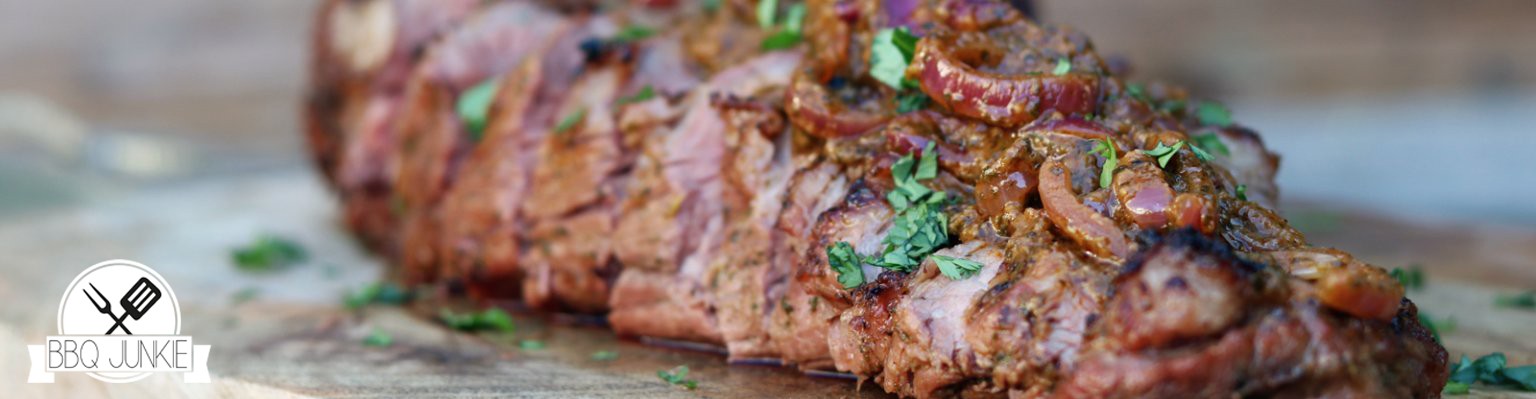
How to cook tri-tip
In Santa Maria, California, tri-tip is part of the local culture, the way a kroket belongs at a Dutch borrel. In the Netherlands you may know it as ezeltje or liesstuk, and honestly: it deserves more attention. Cooking tri-tip comes down to a few steps: sear it brown all over in a hot pan, let it come up to temperature slowly in a 120 °C oven and take it out at 50 °C. Rest it for ten minutes, slice it against the grain and you're done. A tri-tip weighs 800 grams to 1.3 kilos on average, so it feeds 3 to 5 people.
Tri-tip at a glance
- Tri-tip comes from the tensor fasciae latae, a muscle at the bottom of the loin (the bottom sirloin), against the thick loin. The name refers to its triangular shape.
- Other names: ezeltje, liesstuk (Dutch), triangle steak, Santa Maria steak and, in Brazil, maminha.
- At The Butchery a tri-tip weighs 800 to 1,300 grams, depending on the breed.
- Tri-tip has a more subtle flavour than picanha and is less marbled. Picanha is more tender and has a thick fat cap.
- The grain runs through the whole cut. Always slice against the grain.
- Sear tri-tip brown all over and finish it in a 120 °C oven. Allow about an hour and a half in total.
- Medium rare is 52 to 54 °C after resting.
- Allow 250 grams per person as a main and 350 to 400 grams for a big eater.
- According to the story, the cut became known in California in the 1950s and grew into a local speciality around Santa Maria.
What is tri-tip, exactly?
Tri-tip is a triangular cut from the bottom of the loin, at the tip of the sirloin. It comes from the same region as picanha, but the meat is slightly coarser in texture and has a character of its own. In America it is one of the most popular BBQ cuts on the West Coast. The nice thing: a tri-tip is forgiving. You can hardly go wrong, as long as you cook to core temperature and slice against the grain.
Which breed of tri-tip should you choose?
The Black Angus USDA Prime is grain-fed, well marbled and, at 800 to 900 grams, the most manageable option. Feeding a bigger group? The Australian Wagyu BMS 8+ at 1.2 to 1.3 kilos is richly marbled and buttery soft. For the ultimate experience there is the Japanese Wagyu A5+ BMS 12 from Kagoshima, at 900 to 1,000 grams. Browse all our tri-tip and can't decide? Call or email us via customer service.
How to cook tri-tip in 6 steps
- Take the tri-tip out of the freezer. Do this a few days beforehand in the fridge, or put it in cold water for a few hours. Then take it out of the fridge an hour before cooking so it can come up to room temperature.
- Pat dry and season. Salt and pepper are enough, or pick a rub. Preheat the oven to 120 °C while you're at it.
- Sear the tri-tip brown all over. Heat a large pan over high heat with a little butter, or use the grill at maximum temperature. Allow 1 minute per centimetre of thickness per side, until the meat is golden brown and the fat edges are crisp. Don't forget the narrow sides.
- Finish it in the oven. Put the tri-tip in a baking dish, with the rendered fat, and place it in the 120 °C oven. Allow about an hour and a half in total, but go by core temperature.
- Take it out of the oven at 50 °C and rest. Let the tri-tip rest for 10 minutes on a board. The core temperature still rises 2 to 3 °C.
- Slice against the grain and serve. How, you can read below.
Which core temperature suits tri-tip?
Use a meat thermometer. With a big cut, measuring is far more reliable than watching the clock. Here's how to cook steak with a meat thermometer. Guideline temperatures after resting:
- Rare: 49 to 51 °C
- Medium rare: 52 to 54 °C
- Medium: 56 to 58 °C
Our tip: go for medium rare, and don't go beyond medium.
Tri-tip on the BBQ or sous-vide
Tri-tip and the BBQ make a good pair. Set up two zones: a hot zone with direct heat and a cooler zone of around 110 °C. Put the tri-tip on the indirect side, close the lid and let it come up to temperature slowly. Is the core around 46 to 48 °C? Then move it to the hot zone and sear it brown for a short time per side. Sous-vide works too: cook it at 54 °C and then sear it briefly in a hot pan.
Slicing tri-tip: watch the grain
The grain is the direction of the muscle fibres, and with a tri-tip it's worth taking a moment to look at it. In many cuts the grain changes direction halfway through. Find the spot where the fibres bend, cut the piece in two there and slice each part separately against the grain into slices of about half a centimetre. Use a sharp knife without a serrated edge. That keeps every slice tender. Want to know more? Read our tips on how to cut steak.
What to serve with tri-tip
Tri-tip is a cut to share. Put the slices on a big board with a salad, grilled corn on the cob, potatoes or roasted vegetables. Sauces that work: chimichurri, herb butter or a steak sauce. Want to marinate it first? Try a mojo marinade and find more inspiration in our recipes. For wine, a Californian zinfandel, an Argentinian malbec or a syrah goes well. With Wagyu, a softer wine such as a pinot noir is a better match.
Fun facts about tri-tip
- Lots of names. In Brazil tri-tip is called maminha, in northern Germany Pastorenstück or Bürgermeisterstück and in Argentina colita de cuadril.
- Stukkie Pasgetrouwd. In Amsterdam tri-tip also goes by the name stukkie pasgetrouwd, Dutch for "just-married piece".
- Santa Maria. Tri-tip became a local speciality around Santa Maria in California in the 1950s. Who exactly came up with the name isn't certain: several butchers claim the credit.
Questions about cooking tri-tip
What is tri-tip? Tri-tip is a triangular cut from the bottom of the loin, at the tip of the sirloin. In the Netherlands it is also called ezeltje or liesstuk.
How long do you cook tri-tip? Sear it brown all over, 1 minute per centimetre of thickness per side, and finish it in a 120 °C oven. Allow about an hour and a half in total. Go by core temperature: take it out of the oven at 50 °C.
Should you sear tri-tip first? In this method you sear it first and then finish it in the oven. On the BBQ you can also reverse it: bring it up to temperature gently first and sear it afterwards.
Is tri-tip tough? No, tri-tip is tender. It only gets tough if you overcook it or slice with the grain. Take it out of the oven at 50 °C and slice against the grain.
How much tri-tip do you need per person? Allow 250 grams per person as a main and 350 to 400 grams for a big eater. On a BBQ with several kinds of meat, about 100 grams per person is enough.
Tri-tip or picanha? Picanha is more tender and has a thick fat cap. Tri-tip has a more subtle flavour, is less marbled and contains less fat.
What is the difference between tri-tip and maminha? None. Maminha is the Brazilian name for the same cut.