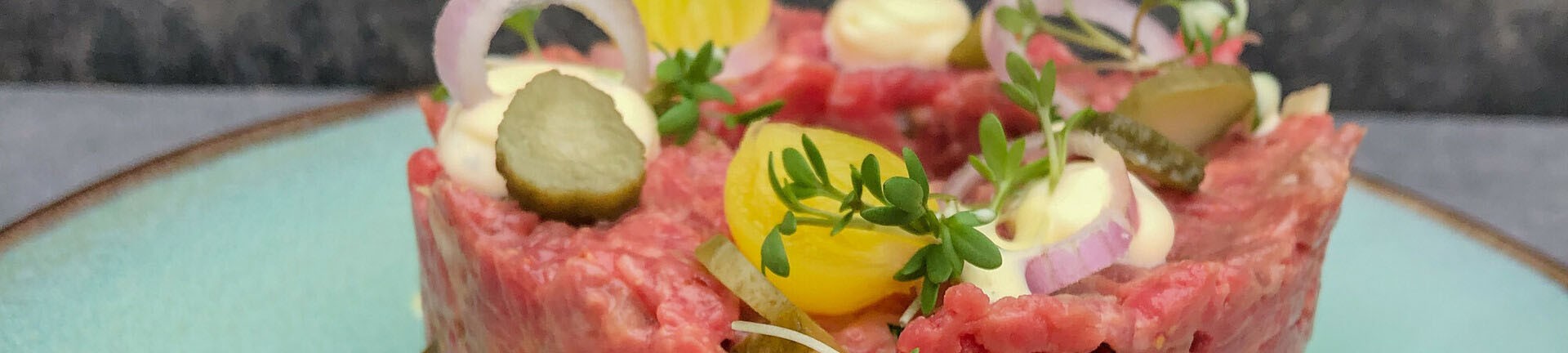
The most underrated steak on the cow
The Petite Tender is a diamond-shaped muscle located above the shoulder blade of the cow. In English it's known as 'Petite Tender' or 'Petite Tender', which literally means "the small tender one". It's a passive muscle, meaning there's almost no connective tissue in it. That's exactly why the Petite Tender is so tender. Each cow only yields two pieces of around 300 to 400 grams, making it a relatively rare cut. Yet it's also an affordable one — unlike tenderloin, which it rivals in tenderness, the Petite Tender doesn't carry a premium price tag. It has long been used in French cuisine for steak tartare, among other dishes, and is now gaining more and more recognition internationally.
Jodenhaas, shoulder tender, Petite Tender: where do these names come from?
The oldest name is jodenhaas (literally "Jewish tenderloin"). According to Jewish dietary laws (kashrut), meat from the hindquarters of the cow is not permitted. Tenderloin (from the loin) is therefore off limits. The Petite Tender sits in the shoulder, at the front of the animal, and is therefore allowed. It became known as "the tenderloin for Jewish people", shortened to jodenhaas.
The name 'diamanthaas' (diamond tender) is Belgian in origin. In the diamond district of Antwerp, a large Jewish community has long enjoyed this cut as an alternative to tenderloin. The fine grain and glistening structure of the meat were reminiscent of a cut diamond. And so the jodenhaas became the diamanthaas. As far as we're concerned, a name that fits perfectly.
Petite Tender vs. tenderloin: what's the difference?
Petite Tender and tenderloin are two completely different cuts that happen to both be very tender. Tenderloin is the most tender cut on the cow and has a subtle flavour — it's the source of tournedos, chateaubriand and tenderloin tips. Petite Tender comes from the shoulder, is more compact and has a fuller, beefier flavour. It's somewhat smaller than the tenderloin but almost equally tender, with more taste. And at a fraction of the price. That's precisely why more and more top restaurants are choosing Petite Tender for their steak tartare.
The difference between Petite Tender and hanger steak
Petite Tender is sometimes confused with hanger steak. They look similar in shape, but the texture is very different. Petite Tender has a fine grain, while hanger steak has a much coarser one. Hanger steak is a bolder, chewier cut — but it rewards you with a deeper, more intense flavour.
The breeds in our range
With Petite Tender, the breed makes perhaps even more difference than with a ribeye or sirloin. Because it's such a compact cut with little surrounding fat, you taste the character of the breed directly. We carry three different varieties, each with their own distinct qualities.
- Simmentaler — Our Simmentaler cattle graze for years on Alpine pastures, giving the steak a full, beefy flavour. Thanks to the natural marbling of this breed, the compact Petite Tender stays extra juicy and tender during cooking. A versatile all-rounder that works in any preparation.
- Black Angus Premium Grassfed — These cattle roam the Argentine pampas and feed exclusively on grass and herbs. This diet gives the meat a robust flavour that sets it apart from grain-fed breeds. Because the Petite Tender is naturally lean, you taste this directly. For lovers of a pronounced beef flavour. Learn more about this breed.
- Black Angus USA — These North American cattle are grain-fed for over 200 days on corn and grains. This diet creates beautiful marbling in the meat. Because the Petite Tender is naturally lean, the grain feeding adds fat — and with it, extra flavour and tenderness. Learn more about this breed.
How we prepare your Petite Tender
Petite Tender is a challenging cut to butcher. It sits between larger muscle groups in the shoulder and must be carefully extracted without damaging the meat. Once removed, the silver skin must be fully stripped away and any irregularities trimmed.
We completely remove the silver skin, trim all edges and sides, and portion to the desired weight. That's our 'triple trimmed' principle: hand-trimmed three times until you have a steak you can take straight from the packaging and put on the grill or in the pan. No trim loss, and you always get the exact weight you pay for — and eat.
After trimming, the steaks are vacuum packed in our 4-layer vacuum foil and flash-frozen at -40 °C within the hour. We do this at the exact moment the steak reaches peak tenderness. Curious about how that process works? Read all about it on our craft butchery page.
How to cook Petite Tender: five methods
The beauty of Petite Tender is its versatility. Because it contains so little connective tissue, you can cook it hot and fast like a steak, or serve it raw as tartare. Here are the five most popular ways to prepare it.
Golden rule: Take the Petite Tender out of the fridge at least 30 to 60 minutes before cooking. Cold meat cooks unevenly.
Pan-searing Petite Tender
- Pat the meat dry and season with salt.
- Heat a pan with oil over high heat and sear for 1.5 minutes per side to build a golden Maillard crust.
- Reduce the heat slightly and add a knob of butter, garlic and thyme to the pan.
- Continuously spoon the melted butter over the meat. This technique is called basting and adds extra flavour.
- Cook the Petite Tender to an internal temperature of 52 °C, then rest loosely under aluminium foil for 5 minutes.
- Slice the Petite Tender against the grain. The grain runs lengthwise, so it's easy to spot.
Petite Tender on the BBQ or kamado
- Fire up the barbecue to a high temperature — aim for 230 °C to 250 °C. Due to its cone shape, the Petite Tender has roughly three 'sides' that need a good crust. This requires direct, high heat.
- Grill each side for approximately 2 minutes (around 6 minutes total). During each 2-minute interval, give the meat a quarter turn halfway through for a clean grill pattern.
- Let the thermometer guide you. Because thickness varies between cuts, timing is only a guideline. Always remove the meat from the grill when it reaches an internal temperature of 52 °C for a perfect medium-rare.
- Rest and slice. Leave the meat to rest for 10 minutes under loosely folded aluminium foil, allowing the juices to redistribute and the internal temperature to rise slightly. Then slice against the grain.
Petite Tender in the oven
- First sear all sides in a hot pan.
- Transfer to a preheated oven at 120 °C and cook slowly to an internal temperature of 52 °C for medium-rare.
- Rest for 5 minutes, then slice against the grain into thin slices.
Petite Tender as steak tartare
This is where Petite Tender truly shines. The famous Parisian brasserie Flo uses Petite Tender for their tartare, and for good reason. It rivals tenderloin in tenderness but delivers a fuller, more complex flavour.
- Place the Petite Tender in the freezer for 10 minutes to firm it up slightly.
- Then hand-cut into small cubes of roughly half a centimetre.
- Never use a blender or food processor — this destroys the texture.
Looking for a full recipe? Check out our Petite Tender steak tartare with brioche and tarragon mayonnaise.
Petite Tender sous vide
- Set your water bath to 54 °C and cook the Petite Tender for 2 hours. Good to know: our vacuum packaging is heat-resistant, so the steak can go straight into the water bath in its packaging.
- After 2 hours, remove the meat from the water bath and rest for 5 minutes.
- Meanwhile, heat a pan with oil over high heat.
- Sear the meat all over until golden brown for a proper crust, then rest again for 5 minutes under loosely folded aluminium foil.
- Slice against the grain into thin slices.
Internal temperature for Petite Tender
In our opinion, Petite Tender is at its best cooked rare to medium-rare. That's when the texture is at its softest and the flavour comes through most clearly. Cook it to medium or beyond and you'll lose some of that tenderness — more so than with a ribeye or sirloin, because Petite Tender has less intramuscular fat to protect the meat from drying out.
Use the following internal temperatures as your guide:
- Rare: 50–52 °C
- Medium-rare: 53–54 °C (our recommendation)
- Medium: 55–58 °C
- Medium-well: 60–64 °C
Because Petite Tender is compact, it can overcook quickly. A meat thermometer isn't a luxury here — it's essential. We've written a detailed guide on cooking steak with a meat thermometer to help you nail it every time.
How much Petite Tender per person?
How much Petite Tender you need per person depends on how you're serving it — as a starter or as a main course. That's a significant difference.
Petite Tender as a starter (e.g. steak tartare):
- Average appetite: 75–100 grams
- Large appetite: 125–150 grams
Petite Tender as a main course:
- Small/average appetite: 250 grams
- Large appetite: 250–400 grams
- Carnivore: 400–500 grams
Recipes with Petite Tender
Petite Tender steak tartare
A recipe by @Duijvelslekker featuring brioche, tarragon mayonnaise, cornichons, pickled onions and shallot. One that's guaranteed to impress. View the recipe.
Petite Tender with caramelised onions and mushrooms
Served with mushrooms, crispy potatoes and a fresh chicory salad. A recipe by @bbqmoods that proves simple is often best. View the recipe.
Do you need to marinate Petite Tender?
You really don't need to marinate Petite Tender. Cuts like bavette have a much coarser grain that readily absorbs marinades. On Petite Tender, a marinade simply doesn't add much. A little salt and pepper is all you need to let the natural flavour of the meat speak for itself.
Buy Petite Tender at The Butchery
Buying Petite Tender online at The Butchery means guaranteed top quality. Every cut passes through the hands of our Master Butchers and comes from authentic beef breeds. The flavour and quality are unquestionably assured.
Order before 11:00 on weekdays and receive your delivery the same evening. Prefer a daytime delivery? No problem — choose your own delivery day and time slot at checkout.
We carry three varieties: Simmentaler, Black Angus Premium Grassfed and Black Angus USA. Every variety is triple trimmed, vacuum packed and flash-frozen at peak tenderness.
Frequently asked questions about Petite Tender
What exactly is Petite Tender?
A cone-shaped muscle from the shoulder of the cow, just above the shoulder blade. It's a muscle that barely moves, meaning there's almost no connective tissue in it. The result is a tender cut that's similar in texture to tenderloin — but with more flavour. Each cow yields only two pieces of Petite Tender.
Where exactly is the Petite Tender located?
In the shoulder, at the top of the front leg, just above the shoulder blade. It's a small muscle protected by larger muscle groups on all sides.
Can I eat Petite Tender raw?
Absolutely. Petite Tender is excellent for steak tartare, carpaccio and tataki. In fact, many top restaurants prefer it over tenderloin for their tartare precisely because of its fuller flavour.
Is Petite Tender the same as tenderloin?
No. Tenderloin comes from the loin (rear), Petite Tender from the shoulder (front). They're comparable in tenderness, but Petite Tender has more flavour and is considerably more affordable. They look similar in shape, but Petite Tender is smaller and more compact.
Which wine pairs with Petite Tender?
A full-bodied red wine with soft tannins. With a pan-seared or grilled Petite Tender we'd go for a Merlot, Syrah or Malbec. For tartare, you can go lighter — a Pinot Noir or even a chilled Beaujolais works beautifully.
How much does Petite Tender cost?
The price varies by breed. The Simmentaler is our most accessible option, the Black Angus USA our most premium. In every case, you only pay for the meat you eat — no trim loss, no added moisture, no packaging weight.
Which vegetables go well with Petite Tender?
Green asparagus, mushrooms, roasted carrots or a fresh chicory salad with walnuts and Parmesan. For tartare, a simple rocket and lemon salad works best. You don't want to overshadow the meat.