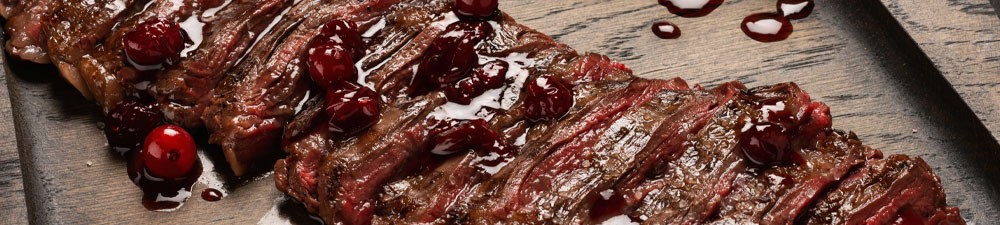
What is a skirt steak?
Skirt steak is cut from the diaphragm of the cow — the muscle that separates the chest cavity from the abdominal cavity and works with every breath. Because it is constantly active, the meat has a firm bite and a full beefy flavour. Skirt steak doesn't excel in tenderness, but it does in character. And that's where the quality of the breed makes or breaks it: a skirt from a lean dairy cow is often tough and flat, while a Black Angus USA or Wagyu skirt is so good you won't know what hit you.
Internationally the cut goes by many names. In Mexico it's called arrachera and is a classic on the grill. In the United States it's the foundation of the famous Philly cheesesteak and fajita beef. And in Argentina, skirt is always found next to picanha on the parrilla. One cut, a world of cuisines.
How did the skirt steak get its name?
The name most likely comes from the English word 'skirt', which refers to the long, flat shape of the meat. With a little imagination, the shape of a skirt steak can remind you of a skirt — and that's exactly where the name comes from.
Inside skirt and outside skirt
Every cow has two types of skirt steak: the inside and the outside. They sit close to each other, but they are genuinely different cuts with their own distinct character. Understanding the difference helps you choose which one suits you best.
Outside skirt
The outside skirt is cut from the diaphragm, between the sixth and twelfth rib. This is the well-kept secret of American steakhouses and South American parrilleros. The meat is thicker, more even and naturally a little more tender than the inside skirt. The marbling is finely distributed between the fibres and melts through the meat as it cooks. The result is a skirt steak that stays juicy over high heat.
At The Butchery you choose from two options: Black Angus USA outside skirt or Australian Wagyu outside skirt.
Inside skirt
The inside skirt comes from the inner chest wall, on the flank side. It's a longer, thinner and slightly coarser cut with a little more connective tissue. That might sound like a downside, but it isn't: the more open fibre structure means marinades are absorbed incredibly fast. This is exactly why the inside skirt is so popular for arrachera, fajitas, tacos and Korean dishes.
At The Butchery we carry the inside skirt in one variant: the Japanese A5 Wagyu inside skirt. And that's no coincidence. This is a cut where the open fibre structure of the inside skirt meets the insane marbling of A5. It doesn't get better than this.
Skirt steak vs flank steak
There's often confusion between skirt steak and flank steak, even though they are genuinely different cuts. Skirt comes from the diaphragm and is thin and long. Flank comes from the belly (flank) and is a wider, more compact piece. The skirt steak has a much coarser grain than the flank steak and a more intense flavour. What both have in common: always slice against the grain.
Why our skirt steak is different
With no other steak does preparation make as much difference as with skirt steak. If the membrane isn't properly removed, the meat will be tough no matter how carefully you cook it. And that's exactly where many suppliers fall short: the skirt is sold with the membrane still partly attached, or only removed from one side. Then you're left trying to do it yourself at home with a knife — which is often a thankless task. We do things differently.
Removing the membrane
On an untreated skirt steak, both sides are covered with a tough, transparent membrane. Leave it on and it contracts during cooking, causing the steak to curl up. Our Master Butchers remove the membrane from both sides before trimming begins.
That sounds obvious, but it rarely happens. It's labour-intensive handwork, and you'll still find plenty of suppliers who skip or rush this step. Not us. This is the foundation of a good skirt steak; without it, the rest of the trimming process is pointless.
Triple trimmed: cut by hand three times
After removing the membrane, the skirt goes through our triple trim process. In practice, that means:
- The tough sinew is removed completely.
- The irregular edges are trimmed by hand. This is essential — a skirt steak cooks in just 3 minutes and needs to be an even thickness throughout.
- Thick fat edges are halved for the perfect meat-to-fat ratio. Enough fat for flavour, not so much that it dominates.
Everything we trim away is our loss, not yours. You only pay for the meat that actually ends up on your plate. And because every skirt is an even thickness, it cooks evenly — no part finishing before the other.
Weight guarantee
We weigh every skirt steak individually after trimming and packaging. The vacuum bag and meat juices don't count. If the weight is still off, we refund the difference. That's our weight guarantee — simple as that.
Flash-frozen at peak of tenderness
Immediately after packaging, the skirt steak goes into the flash-freezer. The meat is frozen within one hour at -40°C, precisely at the moment it has reached its optimal tenderness. With skirt steak, that really makes a difference. The open fibre structure is extremely sensitive to moisture loss. Slow freezing creates large ice crystals that damage the fibres, causing most of the juices to be lost during thawing. With flash-freezing that doesn't happen: flavour, juices and structure are fully preserved.
Want to know more about how we work? Read all about our craft.
Skirt steak around the world
Few cuts are as culturally embedded as skirt steak. In North and South American cuisine it plays a starring role, while in Europe it remained underappreciated for a long time. Three traditions worth exploring:
Mexican arrachera
In Mexico, skirt steak is never just skirt — it's arrachera. Marinated for several hours in a mix of lime juice, soy sauce, garlic, cumin and smoked paprika, sometimes with a splash of tequila or Mexican beer. Then grilled briefly and hot, sliced into thin strips and served on warm corn tortillas with guacamole, pico de gallo and fresh coriander. This is where the inside skirt proves its worth.
American Philly and fajita
In the United States, skirt is the soul of two iconic dishes.
- The Philly cheesesteak from Philadelphia: thin strips of skirt steak, quickly seared on a plancha with caramelised onions and melted cheese on a long roll.
- And the Tex-Mex fajita: skirt grilled with peppers and onion, rolled up in a warm tortilla.
Argentinian parrilla
In Argentina and Uruguay, skirt steak (known there as entraña) is always on the parrilla. No marinades — just coarse sea salt and the heat of the fire. Slice across the grain and serve with authentic chimichurri. This is skirt steak at its most pure, and probably the best way to experience the quality of an outside skirt.
How to cook skirt steak
Everything you need to know about cooking skirt fits on a beer mat. Cook it fast over high heat, keep a close eye on it, pull it at the right moment and slice against the grain after resting.
Preparation
- Take the skirt out of the fridge 30 to 45 minutes before cooking so it comes to room temperature.
- Pat it dry thoroughly with kitchen paper. Skip this step and you'll miss the crust.
- Season with coarse sea salt and freshly ground pepper. Or marinate the steak (see below) — especially recommended for the inside skirt.
Skirt steak on the BBQ
- You want high direct heat at 250°C or more.
- Sear the steak for 1.5 to 2 minutes per side. The high heat creates the beautiful crust and smoky flavour that defines skirt steak.
- Rotate the steak a quarter turn on each side halfway through for perfect grill marks.
- Pull it at an internal temperature of 52°C and rest for 5 minutes loosely covered with aluminium foil.
- Slice against the grain.
Skirt steak in the pan
- Heat a heavy pan over high heat with a little oil.
- Cook the skirt steak for 1.5 minutes per side for a beautiful brown crust.
- Turn the heat down and add a generous knob of butter, crushed garlic and chilli.
- Baste the steak continuously with the butter (arroser) until the core reaches 52°C.
- Remove from the pan and rest for 5 minutes, loosely covered with aluminium foil.
- Squeeze some lime over the meat and sprinkle with fresh coriander.
- Slice the steak against the grain into thin strips.
Marinating skirt steak
Skirt steak is the perfect cut for marinating. Thanks to the open fibre structure (especially with the inside skirt), the meat absorbs flavours incredibly fast. This is our favourite classic Mexican marinade:
- Juice of 2 limes
- Juice of 1 orange
- A generous splash of Mexican beer (or a small dash of tequila)
- 2 tablespoons soy sauce
- 2 tablespoons neutral oil (e.g. sunflower oil)
- 3 finely chopped garlic cloves
- 1 tablespoon chipotle in adobo sauce, or 1 teaspoon chipotle powder
- 1 teaspoon ground cumin
- 1 teaspoon (Mexican) oregano
- A handful of fresh coriander (including the stalks — there's a huge amount of flavour there)
- Salt and black pepper to taste
Marinate the meat for at least one hour and up to 8 hours in the fridge. Don't leave the steak in the marinade for more than a day — the acids from the citrus fruit will break down the meat fibres too far, and you'll lose that beautiful texture.
Internal temperature skirt steak
With skirt steak, a meat thermometer is not a luxury. The margin between perfectly medium rare and tough and overcooked is genuinely small. Use these temperatures as your guide:
- Rare: 49–51°C
- Medium rare: 52–54°C — our recommendation
- Medium: 55–57°C
During resting, the internal temperature rises another 2 to 3 degrees (carryover cooking). Pull the steak from the heat a little earlier than you think.
Slicing skirt steak: always against the grain
With skirt steak, slicing is at least as important as cooking. Maybe even more so. The coarse muscle fibres run clearly in one direction. Always slice at a right angle (across) to those fibres. This breaks them up and makes every bite tender. Slice with the grain and you'll end up with a shoe sole, no matter how well you've cooked it.
With a long skirt, it works well to first divide it into sections of about 10 centimetres (with the grain), then slice those blocks thinly against the grain.
How much skirt steak per person?
Skirt steak is wonderful to cook whole and carve at the table. Use these weights as a guide per person:
Skirt steak as a main course
- Average eater: 175–200 grams
- Big eater: 250–300 grams
- Hardcore carnivore: 400+ grams
Skirt steak to share (for 2)
- Average eaters: 400 grams
- Big eaters: 500+ grams
BBQ with multiple cuts
- Light eater: 75 grams
- Big eater: 150 grams
- Carnivore: 200 grams
Skirt steak recipes
Few cuts are this versatile, and our ambassadors love them for it. We have plenty of skirt steak recipes — here are our favourites:
Find all recipes on our recipe page.
Buy skirt steak online
Looking to buy skirt steak online? At The Butchery you choose from three variants: Black Angus USA outside, Australian Wagyu outside or Japanese A5 Wagyu inside. All available in different weights. Learn more about the breeds: Black Angus USA and Australian and Japanese A5 Wagyu.
We deliver throughout the Netherlands and Belgium. Order on a weekday before 11:00 and you'll receive your meat the same evening, frozen via refrigerated transport (Chill Bill) or with dry ice in an insulated bag (Trunkrs). You can put the skirt steak straight back in the freezer when it arrives — perfect if you're planning a BBQ or stocking up ahead of a dinner.
Prefer to choose in person? Come visit our Flagship Store in Meppel — our butchers are there to give you personal advice.
Frequently asked questions about skirt steak
What is skirt steak?
Skirt steak is cut from the diaphragm of the cow — the muscle between the chest and abdominal cavity. The English name 'skirt' refers to the long, flat shape of the cut.
What is the difference between inside and outside skirt?
The outside skirt comes from the diaphragm and is thicker, more even and more tender. Ideal as a pure steak on the grill. The inside skirt comes from the inner chest wall, is thinner and has a more open fibre structure that absorbs marinades incredibly fast. This makes it perfect for arrachera, fajitas and tacos. At The Butchery you'll find an A5 Wagyu inside skirt and two outside skirts (Black Angus USA and Australian Wagyu).
Skirt steak or flank steak: what's the difference?
Skirt comes from the diaphragm and is thin, narrow and elongated. Flank comes from the belly flank and is wider and more compact. Both have a coarse grain, but skirt is more intense in flavour.
Is skirt steak tough?
Skirt naturally has more bite than a tenderloin, for example — it is a working muscle after all. But with the right breed, a properly trimmed steak, a short and hot cook and slicing against the grain, skirt is by no means tough. That bite is part of its character.
Should I marinate skirt steak?
Not mandatory, but highly recommended — especially for the inside skirt. The open fibre structure absorbs flavours incredibly fast. A marinade with lime juice, soy sauce, garlic and a neutral oil works fantastically. Just make sure you don't leave the meat in an acidic marinade for more than 8 hours, otherwise the structure breaks down too much and you'll lose that beautiful bite.
How do you slice skirt steak?
Always against the grain. The coarse muscle fibres run clearly in one direction. By cutting across them, you break them up and every bite becomes tender. Slice with the grain and even a perfectly cooked skirt becomes a shoe sole.