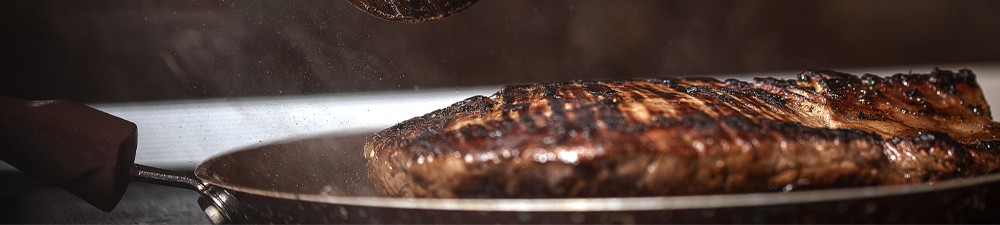
What is a bavette?
Bavette is cut from the abdominal flank of the cow. There are only two bavettes per cow, weighing about 800 grams to 1.5 kilos each, which makes it a relatively scarce piece of meat.
For a long time, it was therefore considered one of the 'forgotten meats', but this cut of beef has since begun a strong comeback. And rightly so! It is a flat piece of 'lean working meat' that has had a lot of movement. Because of this, the meat consists of long, coarse muscle fibers. This gives bavette a firm bite and a tremendous amount of flavor. Provided it's from a good beef breed, because we do not recommend a bavette from a skinny dairy cow...
Bavette, maanvlees or vanglap?
Bavette has quite a few names. In the Netherlands and Belgium, many people nowadays simply know it as bavette, but you might also know it as vanglap, vinkelap, or maanvlees. The latter is due to its characteristic half-moon shape.
In English, it is called flap steak or flap meat. The name bavette itself comes from French. But it doesn't matter what you call it: it is always the same delicious piece of meat.
What is the difference between bavette and flank steak?
There is quite a bit of confusion about what bavette is and what flank steak
The bavette has a coarser structure and a longer grain. Flank steak is more compact, with a tighter fiber structure. It can sometimes happen that if you order bavette from a butcher who does not specialize in special meats, you receive flank steak.
The big difference is mainly in the slicing. Because of that coarser grain, bavette benefits even more from being cut against the grain. If you do that right, you really have a flavor bomb on your hands.
Why buy bavette at The Butchery?
Bavette is a cut of meat that stands or falls with how it is prepared. A sloppily trimmed bavette has loose pieces, stiff connective tissue, and irregular edges. That difference in thickness causes the meat to cook unevenly, and for a piece that you have to cook short and hot, that is truly disastrous. That is why we pay so much attention to it.
Triple trimmed: bavette 100% grill-ready
At The Butchery, every bavette is handled by our Master Butchers according to our standards
The connective tissue is completely removed.
The ends and irregular edges are cut off by hand for an even thickness.
Finally, the bavette is hand-portioned into perfect steaks.
Why does that matter? A bavette with an even thickness cooks at the same speed everywhere. With a steak that you only cook for 2 to 4 minutes per side, that is the difference between a perfectly cooked bavette and one that is cooked on one side and raw on the other. An additional advantage: by removing all the trimming waste beforehand, you only pay us for the meat you actually eat.
Flash-frozen at the right moment
After trimming, the bavette goes straight into our flash freezer
And precisely with bavette, that makes a big difference. Due to the coarse fiber structure, bavette is more sensitive to moisture loss than a tournedos, for example. Slow freezing causes large ice crystals that damage those coarse fibers. When thawing, you then lose exactly the juice that gives the bavette its flavor. With flash-freezing, this does not happen. The moisture, flavor, and structure remain completely intact.
Vacuum-packed and sous-vide ready
Every bavette is individually packed in our specially developed 4-layer vacuum foil. The extra nylon layer makes the packaging puncture-resistant – handy, because that way you will never have a leaky package in the freezer again. In addition, our vacuum foil is heat-resistant up to 70°C. That means you can prepare the bavette sous-vide directly in our packaging.
Weight guarantee
At The Butchery, you pay for meat, not for packaging or moisture. We weigh each piece individually after it has been trimmed and packed. Is the weight incorrect? Then you will be refunded the difference. It's that simple.
Want to know more about how we work? Read all about our craft
Which breed of bavette should you choose?
Which bavette suits you best depends on what you are looking for. Bavette is inherently a robust piece of meat with more bite than, for instance, a tournedos or tenderloin. That character is enhanced or softened by the breed. Below is a list of several options.
Bert-Jan's favorite: Australian Wagyu
If you ask Bert-Jan about his favorite bavette, he doesn't have to think long: the Australian Wagyu bavette
Bavette is a working muscle with a coarse grain. With most breeds, that is exactly the character you are looking for. But with Australian Wagyu
The all-rounder: USDA Prime Black Angus
The Black Angus PRIME bavette from the US
Competitively priced: Black Label Angus
The Black Label Angus
Are you in doubt about which breed suits you? Feel free to contact us
How do you prepare the perfect bavette?
Preparing bavette is quite precise. Because if it is overcooked, you get tough meat. That is why we recommend not cooking it further than medium. Below are the most popular methods.
Bavette on the BBQ (reverse sear)
The reverse sear
Take the bavette out of the fridge at least 30–60 minutes in advance.
Prepare the BBQ for indirect grilling at 120°C.
Grill the bavette indirectly to a core temperature of 40°C (about 20–40 minutes, depending on the thickness).
Remove the meat from the BBQ and let it rest for 5–10 minutes.
Prepare the BBQ for direct grilling at 230–250°C. Preferably use a cast-iron grate.
Sear the bavette for 1–2 minutes per side until reaching a core temperature of 52°C (medium rare).
Let rest for another 5 minutes, cut against the grain.
Do you have a thinner piece of bavette (less than 4 cm)? Then we advise you to only grill it directly over high heat: 2–4 minutes per side until a core of 52°C.
Pan-frying bavette
Pat the bavette dry with paper towels and sprinkle with salt.
Heat the pan over high heat with a dash of oil.
Turn the pan down a bit in the last three minutes and add butter.
Use a spoon to continuously baste the butter over the meat.
In total, you fry the bavette for about 2–3 minutes per side for medium rare, 3–4 minutes for medium. Depending on the thickness, of course.
Let the meat rest for 5 minutes and cut against the grain.
Preparing bavette in the oven
You can also perfectly prepare a whole piece of bavette in the oven. Sear the bavette until golden brown on all sides in a hot pan with oil. Then place the meat with the cooking fat in a baking dish and cook at 120°C until the desired core temperature. Let rest for 5–10 minutes before slicing.
Preparing bavette sous-vide
Do you want to cook the bavette even more precisely? Then sous-vide is the ideal method. Because you set the temperature exactly to the degree, it is virtually impossible to overcook the bavette – and with this cut of meat, that is exactly what it is all about.
Set the water bath to 52°C for medium rare (or 55°C for medium).
Place the bavette in the water bath. You can place the bavette in our vacuum packaging directly into the water bath (it is heat-resistant up to 70°C).
Cook the bavette for 2 to 4 hours, depending on the thickness. Due to the longer cooking time, the coarse fibers become extra tender.
Remove the bavette from the water bath after that time.
Briefly sear the meat in a piping hot pan or on the BBQ: maximum 1 minute per side for a crispy crust.
Let rest for 5 minutes and cut against the grain.
The advantage of sous-vide with bavette? The meat is cooked evenly from edge to edge, while the coarse fiber structure benefits extra from the longer cooking time at a low temperature. The result is maximum tenderness with all the flavor intact.
Bavette core temperature
If you want the perfect result, you must use a meat thermometer
Rare: 49–51°C
Medium rare: 52–54°C (our recommendation)
Medium: 55–57°C
Well done: 62°C+
Keep in mind that the meat's temperature will rise another 2–3 degrees after cooking (carryover cooking). So take your bavette off the heat slightly before your desired final temperature.
Slicing bavette
Slicing the bavette
VIDEO
Marinating bavette
A bavette is very suitable for marinating
Put the marinade in a baking dish, place the bavette in it. Let the bavette marinate for at least 2 hours in the fridge, but longer is always better!
VIDEO
Recipes with bavette
You can go in any direction with a bavette. Because it is a long and flat piece of meat, you could, for instance, make a roulade or so-called pinwheels out of it. You then have to butterfly the bavette first to fill and roll it up.
We have many more recipes with bavette, so plenty of inspiration:
Ordering bavette from The Butchery
At The Butchery, you can choose from bavettes of various beef breeds. From a competitively priced Aberdeen Angus to Australian Wagyu for a special occasion. Every piece is hand-trimmed and portioned by our Master Butchers. Then vacuum-packed and flash-frozen at -40°C within the hour.
Do you order on a workday before 11:00 AM? Then we deliver throughout the Netherlands and Flanders the very same evening, deep-frozen via refrigerated transport or with dry ice. Do you want to buy bavette but are unsure which breed? Our butchers are happy to think along with you.
Frequently asked questions about bavette
What kind of meat is bavette?
Bavette is a cut of beef from the flank. It is relatively lean with a coarse fiber structure and a full flavor. Other names are vanglap, vinkelap, and maanvlees. In English, it is called flap steak or flap meat.
How do you prepare bavette?
Take the bavette out of the fridge at least 30 minutes in advance. Season with salt and pepper. Fry or grill over high heat, 2–3 minutes per side. Let it rest for 5 minutes and always cut against the grain.
How much bavette per person?
Count on 150–200 grams per person as a side dish. Is the bavette your main course? Then go for 200–250 grams per person.
Is bavette tender?
By nature, bavette is a firmer piece of meat – it is a working muscle, after all. But with the right preparation (short and hot) and by slicing against the grain, bavette is actually very tender.
How long should bavette rest?
Let the bavette rest for at least 5 minutes after cooking. This ensures that the juices are distributed throughout the meat. Please note: the core temperature rises another 2–3 degrees during resting. So keep this in mind.
How do you cut bavette?
Always cut a bavette perpendicular (across) to the grain. The coarse muscle fibers run clearly visible in one direction. By cutting across them, you break up the fibers and make every bite tender. Do you cut with the grain? Then you are guaranteed a tough piece of meat.
Which sauce pairs with bavette?
A bavette has so much flavor of its own that, as far as we are concerned, a sauce is not strictly necessary. Do you still prefer to eat it with one? Then choose chimichurri, a pepper sauce, red wine sauce, or garlic butter.
How much does bavette cost per kilo?
The kilo price of bavette differs per beef breed. Premium breeds such as Wagyu or USDA Prime are higher in price, but offer much more flavor and tenderness. Because of our trimming process, you only pay for the meat you actually eat at The Butchery.
Where can I buy the best bavette?
At The Butchery, bavettes are hand-trimmed and portioned into grill-ready steaks by our Master Butchers. We work exclusively with premium beef breeds, and on every product page you will find the customer reviews that confirm our craftsmanship.