







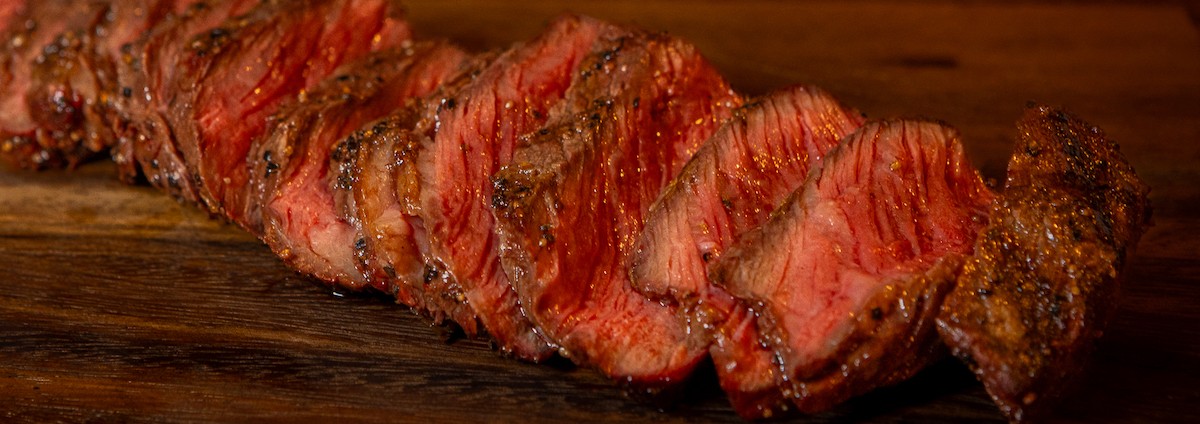
How to cook Denver steak in 4 steps
Ribeye and entrecote have been around for centuries. Denver steak only since 2008. That's when American researchers discovered a muscle hiding under the shoulder blade that was far more tender than anyone expected. The result: a marbled steak you cook hot and fast. Allow 1 minute per centimetre per side, take it off the heat at 50 °C, rest it for 5 to 10 minutes and slice it against the grain.
Denver steak at a glance
- Denver steak comes from the serratus ventralis, a muscle just under the shoulder blade in the chuck. A cow has two of them.
- The Denver steak got its name in 2008, when the American National Cattlemen's Beef Association (NCBA) researched underappreciated muscles. The name has nothing to do with the city of Denver.
- In Japan the same muscle is called zabuton, which means "sitting cushion". Butchers also call it chuck under blade or underblade filet.
- According to The Butchery, the NCBA research showed this muscle to be the fourth most tender of the whole animal.
- The muscle sits protected under the shoulder blade and has even, fine marbling.
- A Denver steak is usually 2 to 4 centimetres thick. Cook it 1 minute per centimetre per side.
- Medium rare is 52 to 54 °C after resting.
- Allow 200 to 250 grams per person for an average eater.
- Denver steak is not the same as flat iron. Flat iron sits above the shoulder blade, Denver below it.
What is Denver steak, exactly?
Denver steak is a shoulder cut that behaves like a premium steak. Because the muscle sits under the shoulder blade, it does very little work. Less work means less connective tissue, and so a steak that is tender after a short cook, while the muscles around it are really braising meat. The marbling runs fine through the grain and melts from the inside out while you cook. It's similar to a ribeye, but the Denver is more compact and slightly milder in flavour.
Which breed of Denver steak should you choose?
The Black Angus USDA Prime is grain-fed and our bestseller: lots of flavour and a nice bite. The grass-fed Black Angus from Argentina is marbled and full of flavour, with a slightly firmer beef taste. For the ultimate experience there is Wagyu. Good to know: Denver steak isn't always in stock, so check our Denver steak page or browse Black Angus USA. Can't decide? Call or email us via customer service.
How to cook Denver steak in 4 steps
- Take the Denver steak out of the fridge 30 to 60 minutes beforehand and pat it dry. Season with coarse salt. Add pepper after cooking, because it burns at high heat and turns bitter.
- Cook the Denver steak in a hot cast-iron pan. Heat the pan over high heat with a splash of oil and add the steak as soon as the oil just starts to smoke. Allow 1 minute per centimetre of thickness per side. A 3 cm steak therefore gets 3 minutes per side.
- Take the steak off the heat at 50 °C and let it rest. The temperature still rises 2 to 3 °C while resting, to medium rare. Rest it for 5 to 10 minutes under a loosely draped piece of aluminium foil.
- Slice against the grain and serve. That keeps every slice tender. Not sure how? Read our tips on how to cut steak.
Which core temperature suits Denver steak?
A Denver steak is relatively thin and cooks through quickly, so a meat thermometer is highly recommended. Here's how to cook steak with a meat thermometer. Guideline temperatures after resting:
- Rare: 49 to 51 °C
- Medium rare: 52 to 54 °C
- Medium: 55 to 57 °C
Our tip: go for medium rare, and don't go beyond medium.
Denver steak on the BBQ, in the oven or sous-vide
On the BBQ, cook the Denver over direct heat of 230 to 250 °C, 2 to 3 minutes per side, and take it off the grill at 50 °C. It doesn't need to go in the oven afterwards. Prefer the oven? Sear the steak in a hot pan first and finish it in a 120 °C oven until the core reaches 50 °C. Sous-vide works too: cook it for 2 to 4 hours at 54 °C and then sear it for no more than a minute per side. That way it's almost impossible to overcook.
What to serve with Denver steak
With a well-marbled Denver, salt and pepper are honestly enough. Want more? A chimichurri or herb butter works well. For wine, go for an Argentinian malbec, a syrah or a cabernet sauvignon. With Wagyu, a softer wine such as a Rioja Crianza is a better match, so the tannins don't overpower the melt. Feeding a crowd? Try these marinated Denver steak skewers.
Fun facts about Denver steak
- Invented in 2008. The name Denver steak is a marketing name from the NCBA. It's probably a nod to Colorado, where the organisation is based.
- Zabuton. In Japan the same muscle is called zabuton: "sitting cushion", after its thick, square shape.
- Neighbour of flat iron. Denver steak and flat iron both come from the shoulder, but they are two different muscles.
Questions about cooking Denver steak
What is Denver steak? Denver steak is a steak from the serratus ventralis, a muscle under the shoulder blade in the shoulder of the cow. The steak is marbled and tender.
Where does the name Denver steak come from? The name was coined in 2008 by the NCBA. There is no real link with the city of Denver. It probably refers to Colorado.
Is Denver steak the same as zabuton? Yes. Zabuton is the Japanese name for the same muscle and means "sitting cushion". Butchers also call it chuck under blade or underblade filet.
How long do you cook Denver steak? Allow 1 minute per centimetre of thickness per side in a hot pan. A 3 cm steak is therefore about 3 minutes per side. Go by core temperature: take it off the heat at 50 °C.
Is Denver steak tough? No. The Denver is tender, as long as you don't cook it beyond medium and slice it against the grain.
How much Denver steak do you need per person? Allow 200 to 250 grams for an average eater and 300 to 400 grams for a big eater.
Denver steak or ribeye? Ribeye has more intramuscular fat and a richer mouthfeel. The Denver is more compact and slightly milder in flavour, but better value.