






How to cook roast beef
When do you actually eat roast beef? In England that's simple: on Sunday. Here in the Netherlands it's the cut for a festive table or a cold platter with mustard and a crusty roll. Either way: cooking roast beef is mostly patience. Sear it brown all over for a short time, let it come up to temperature slowly in a 120 °C oven and take it out at 50 °C. Rest it for ten minutes, slice it thinly against the grain and you're done. A roast beef of 800 grams to 1 kilo feeds 3 to 4 people.
Roast beef at a glance
- Roast beef is cut from the round, the hindquarter of the cow, from the eye of round or sirloin tip. In Dutch it's called rosbief.
- Roast beef is naturally lean. Don't cook it too long, or it will dry out.
- The name comes from the English roast beef.
- At The Butchery a roast beef weighs from about 400 grams up to about 1.7 kilos, depending on the breed and size.
- Sear the roast beef brown all over for a short time and finish it in a 120 °C oven.
- Take it out at 50 °C. Medium rare is 52 to 54 °C after resting.
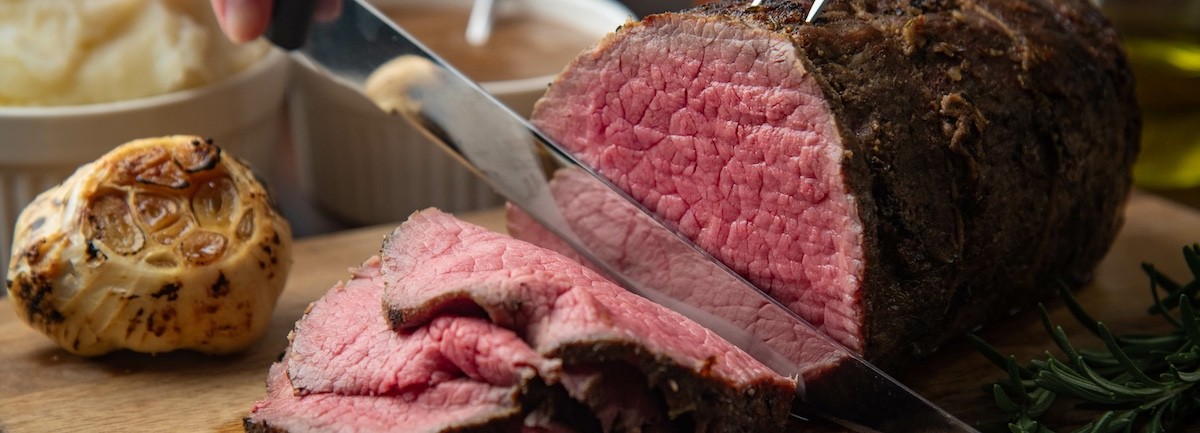
- Rest it for 10 minutes and slice it thinly against the grain.
- Allow 150 to 250 grams per person for an average eater and 250 to 400 grams for a big eater.
- You can eat roast beef warm or cold, in thin slices.
- A roast beef from The Butchery is delivered flash-frozen and can go back in the freezer.
What is roast beef, exactly?
Roast beef is a lean, even cut from the hindquarter of the cow. The meat has little fat and a fine texture, which is why it's so well suited to thin slices: warm with gravy or cold on a platter. Because there's so little fat to protect the meat while it cooks, the core temperature matters more than with a marbled cut. A few degrees too far and the roast beef turns dry. A thermometer is your best friend here.
Which roast beef should you choose?
At The Butchery you'll find several roast beef cuts from the round. The Black Angus USDA Prime is grain-fed and well marbled. It comes from 600 grams, ideal for a small group, and in larger sizes for a bigger table. Prefer grass-fed and lean? Then there's the Blonde d'Aquitaine eye of round roast from 800 grams, or the veal eye round from 400 grams. Short on time? There's also a seasoned eye of round roulade from Black Angus USDA Prime. Can't decide? Call or email us via customer service.
How to cook roast beef in 5 steps
- Take the roast beef out of the freezer. Do this a few days beforehand in the fridge, or put it in cold water for a few hours. Then take it out of the fridge well in advance, so it can come up to room temperature.
- Pat dry and season. Use salt and pepper, or a rub. Fancy a herb mix? Try finely chopped rosemary, garlic and a pinch of chilli flakes. Preheat the oven to 120 °C while you're at it.
- Sear the roast beef brown all over. Heat a pan over high heat with a little butter, or use the grill at maximum temperature. A roast beef isn't a steak, so the rule of 1 minute per centimetre doesn't apply here: sear it brown all over in a few minutes and no longer. It's lean and dries out quickly.
- Finish it in the oven. Put the roast beef in a baking dish and place it in the 120 °C oven. Allow roughly an hour for a piece of 600 to 1,000 grams, longer for bigger ones, but go by core temperature and take it out at 50 °C.
- Rest and slice. Let the roast beef rest for 10 minutes on a board, under a loosely draped piece of aluminium foil. The temperature still rises 2 to 3 °C. Then slice it thinly against the grain.
Which core temperature suits roast beef?
Use a meat thermometer, because with a lean cut a few degrees make the difference between juicy and dry. Here's how to cook steak with a meat thermometer. Guideline temperatures after resting:
- Rare: 49 to 51 °C
- Medium rare: 52 to 54 °C
- Medium: 56 to 58 °C
Our tip: go for medium rare, and with a lean cut like roast beef don't go beyond medium.
Roast beef on the BBQ or sous-vide
Roast beef is a great cut for the BBQ too. Sear it brown all over over direct heat, then move it to the indirect side at around 120 °C, close the lid and take it off the BBQ at 50 °C. Sous-vide works too, and then you hardly need to watch the core temperature. Check first that the vacuum bag is intact. Cook the roast beef for 3 hours at 52 °C for rare, 54 °C for medium rare or 57 °C for medium, and then sear it briefly for a golden-brown crust.
Slicing roast beef: thin, and against the grain
You almost always eat roast beef in thin slices. Find the direction of the muscle fibres, that's the grain, and cut across it. Use a sharp knife without a serrated edge. Want to eat it cold? Let it cool completely first, preferably overnight in the fridge. Cold, you can slice it much thinner and neater. More tips? Read how to cut steak.
When do you eat roast beef?
Roast beef belongs to the days when you take your time at the table. In England it's the heart of the Sunday roast, the Sunday meal traditionally eaten after church. A Sunday roast comes with its own sides: Yorkshire pudding, roast potatoes, vegetables, gravy and horseradish. National Geographic even calls roast beef with Yorkshire pudding the national dish of England. In the Netherlands we usually eat roast beef in two ways: warm as a main course at a Sunday or festive dinner, or cold in thin slices on a roll, on a platter or at a buffet. Both work, which makes roast beef a smart choice when you're cooking for a group: you can make it the day before and have nothing left to do on the day itself.
What to serve with roast beef
Warm, roast beef goes well with gravy, roasted potatoes and seasonal vegetables. Cold, a crusty baguette with mustard, mayonnaise or horseradish and a fresh salad is a great combination. A herb butter, such as Cowboybutter or Chimichurri, adds extra flavour. For wine, a red Bordeaux, a Burgundy or a Rioja goes well.
Fun facts about roast beef
- The English name. The Dutch word rosbief comes from the English roast beef. The Dutch spell it the way they say it.
- In the oven before church. According to one story, English families at the end of the eighteenth century put the meat in the oven before going to church and came back to an almost finished dinner. The pan juices became the gravy.
- Back in the freezer. A roast beef from The Butchery is delivered flash-frozen and, if you don't use it, can go straight back in the freezer.
Questions about cooking roast beef
What is roast beef? Roast beef is a lean cut from the round, the hindquarter of the cow. The meat has a fine texture and is usually eaten in thin slices.
How long do you cook roast beef? Sear it briefly brown all over and finish it in a 120 °C oven. For a piece of 600 to 1,000 grams allow roughly an hour. Go by core temperature: take it out of the oven at 50 °C.
When do you eat roast beef? Warm, roast beef is a great main course for a Sunday or festive dinner. Cold, you eat it in thin slices on a roll, on a platter or at a buffet. In England it's the heart of the Sunday roast.
Why does roast beef dry out? Roast beef is lean. If you cook it too long or too hot, it dries out. So take it out of the oven at 50 °C and let it rest.
How much roast beef do you need per person? Allow 150 to 250 grams for an average eater and 250 to 400 grams for a big eater. For a real carnivore, 400 to 600 grams is realistic.
Can you eat roast beef cold? Yes. Let it cool completely first, preferably overnight in the fridge, and then slice it as thinly as possible against the grain.
Can a roast beef go back in the freezer? A roast beef from The Butchery is delivered flash-frozen and can go back in the freezer. Always thaw it slowly in the fridge.